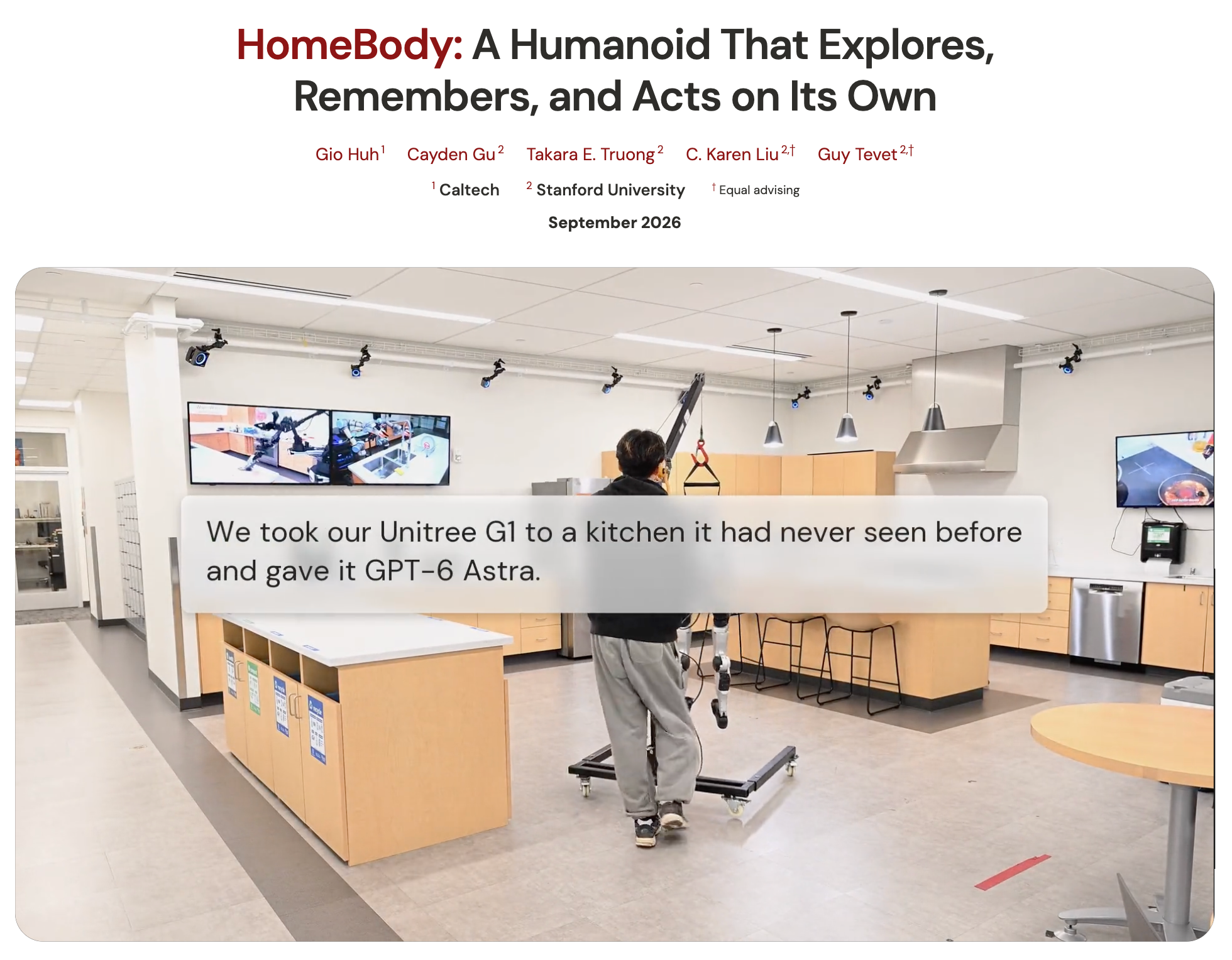
Caltech, Stanford unveil HomeBody system to give GPT Astra spatial memory for humanoid robots
Researchers at Caltech and Stanford have unveiled HomeBody, a system that gives GPT Astra persistent spatial memory and the ability to execute compound humanoid actions for long-horizon tasks. In a kitchen demo, a Unitree G1 robot guided by Astra cleaned the room and retrieved remembered items from ambiguous requests. The team said the system requires no environment-specific training or additional policy learning. HomeBody replaces the trained intermediate VLA layer in conventional three-part architectures—System2 VLM for vision and instructions, System1 VLA for control commands, and System0 for coordinated motion. As frontier models such as Astra improve, the researchers argue trained VLAs are no longer necessary and System2 can directly manage reusable motion skills. A plug-and-play VLM calls a composable skill library....
 the 2026 Bund Summit