
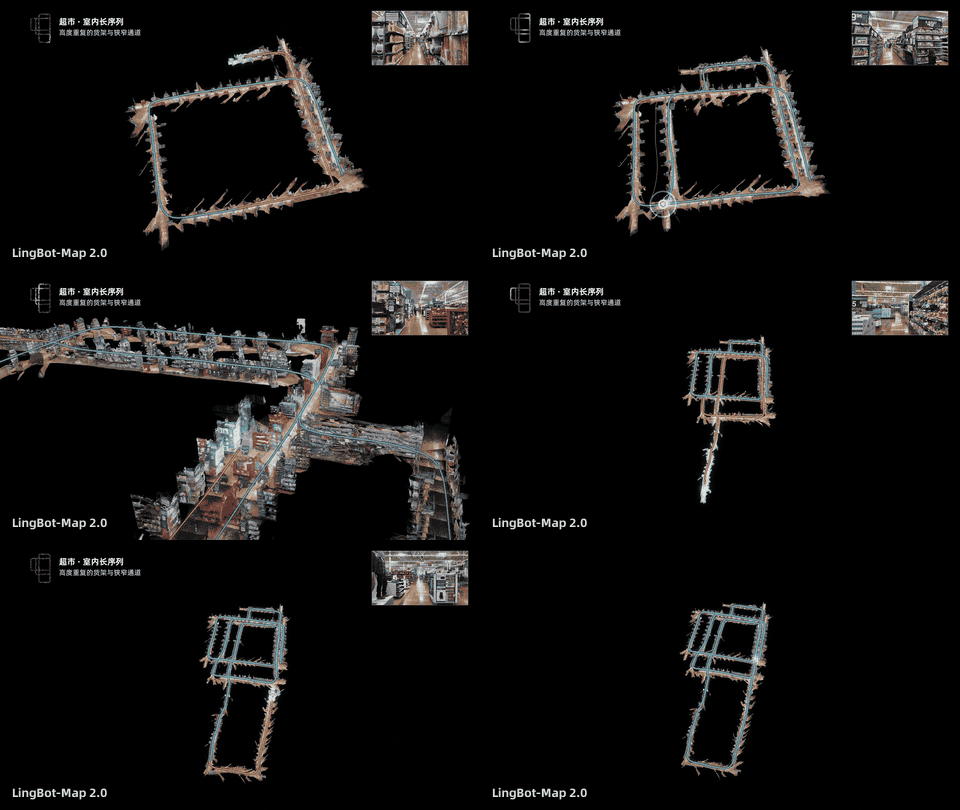
Robbyant releases LingBot-Map 2.0, a streaming 3D reconstruction model, and open-sourced LingBot-Navi, a navigation model with spatial memory, strengthening the spatial-memory and autonomous-navigation capabilities of its embodied native general-purpose brain. The company said the two models address two bottlenecks in robot autonomy: drift in long-distance streaming mapping and poor route recall in cross-task navigation. LingBot-Map 2.0 reconstructs 3D space in real time from continuous monocular RGB video and corrects accumulated drift inside the model, rather than relying on an external pose-graph optimization backend. LingBot-Navi uses LingBot-Map 2.0 to build reusable 3D spatial memory across tasks, follow natural-language instructions to locate targets, plan routes and navigate to docking points near targets. LingBot-Map 2.0 uses a Geometric Context Reconsolidation design inspired by...
Robbyant released LingBot-Map 2.0, a streaming 3D reconstruction model, and open-sourced LingBot-Navi, a navigation model with spatial memory, strengthening the spatial-memory and autonomous-navigation capabilities of its embodied native general-purpose brain.
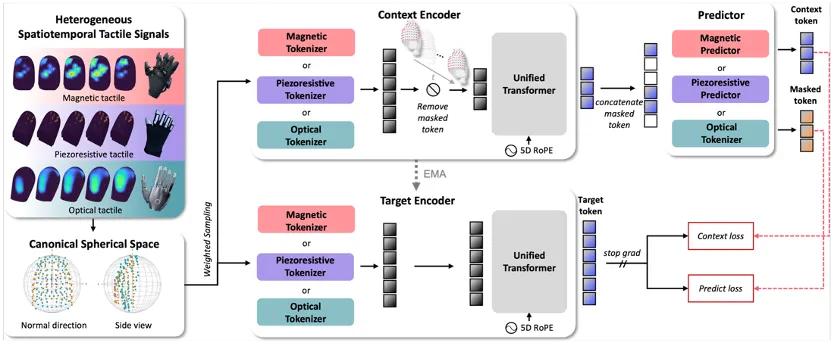
Robbyant release LingBot-Touch, a tactile foundation model pretrained on nearly 5,000 hours of real tactile data. It converts magnetic, vision-based and piezoresistive signals into a unified representation for dexterous hands and action models, adding touch sensing for fine manipulation. The model and code are open-sourced on Hugging Face, GitHub and ModelScope.
Robbyant said it has open-sourced LingBot-Touch, a tactile foundation model designed to give robot “brains” the contact sensing needed for fine manipulation, based on nearly 5,000 hours of real tactile data. The model covers three mainstream sensing principles — magnetic, vision-based and piezoresistive tactile sensing — and converts their different raw signals into a common tactile representation for use across dexterous hands and action models, the company said. The release extends Ant Lingbo’s embodied AI stack from visual perception and task reasoning to fingertip sensing. LingBot-Touch has been integrated with LingBot-VLA, the company’s vision-language-action model, according to Ant Lingbo. Tactile sensing is increasingly seen as a complement to vision in robotic manipulation. In tasks such as unscrewing a bottle cap,...
 AGIBOT
 Figure AI
 UBTECH