Robbyant releases LingBot-Map 2.0, a streaming 3D reconstruction model, and open-sourced LingBot-Navi, a navigation model with spatial memory, strengthening the spatial-memory and autonomous-navigation capabilities of its embodied native general-purpose brain.
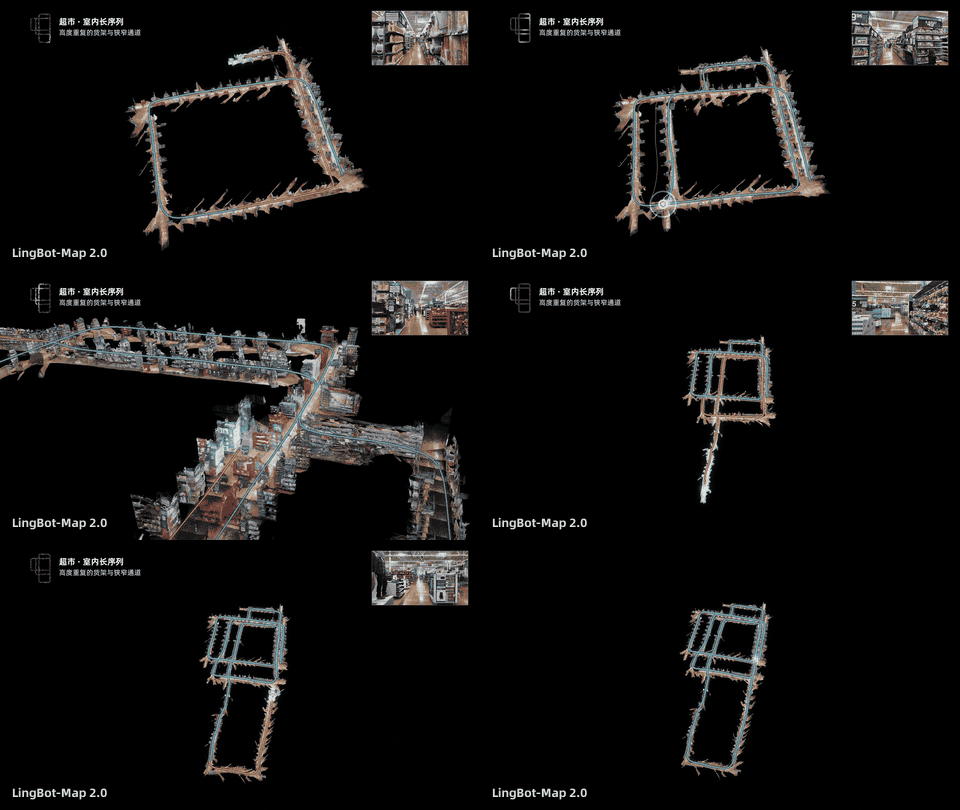
The company said the two models address two bottlenecks in robot autonomy: drift in long-distance streaming mapping and poor route recall in cross-task navigation. LingBot-Map 2.0 reconstructs 3D space in real time from continuous monocular RGB video and corrects accumulated drift inside the model, rather than relying on an external pose-graph optimization backend. LingBot-Navi uses LingBot-Map 2.0 to build reusable 3D spatial memory across tasks, follow natural-language instructions to locate targets, plan routes and navigate to docking points near targets.
LingBot-Map 2.0 uses a Geometric Context Reconsolidation design inspired by memory reconsolidation in the human brain, the company said. It reuses extracted local geometry during correction, realigns high-level historical memory and writes it back to cache, so that later planning is based on updated spatial memory rather than only a corrected trajectory. The model also draws on LingBot-Vision, a self-developed visual foundation model with sub-pixel boundary localization and spatial structure understanding.
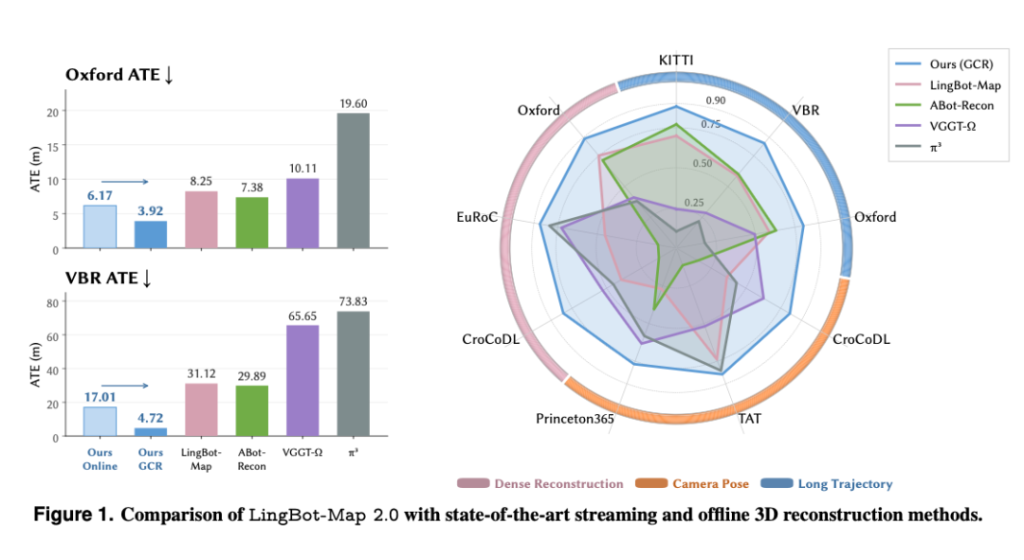
In tests across seven public datasets and nine evaluation settings, LingBot-Map 2.0’s online mode outperformed existing streaming methods on almost all metrics and ran at 27.51 frames per second on a single RTX 5090, according to the company. On the VBR urban long-trajectory test of up to 5.2 km and nearly 19,000 frames, average trajectory error fell to 4.72 meters from 31.12 meters in version 1.0, a reduction of nearly 85%, and was less than half the 9.98 meters achieved by the best external loop-closure method. Error fell to 3.92 meters on Oxford Spires and 9.42 meters on KITTI. The model ranked first on the CroCoDL, EuRoC and Oxford dense 3D reconstruction benchmarks.
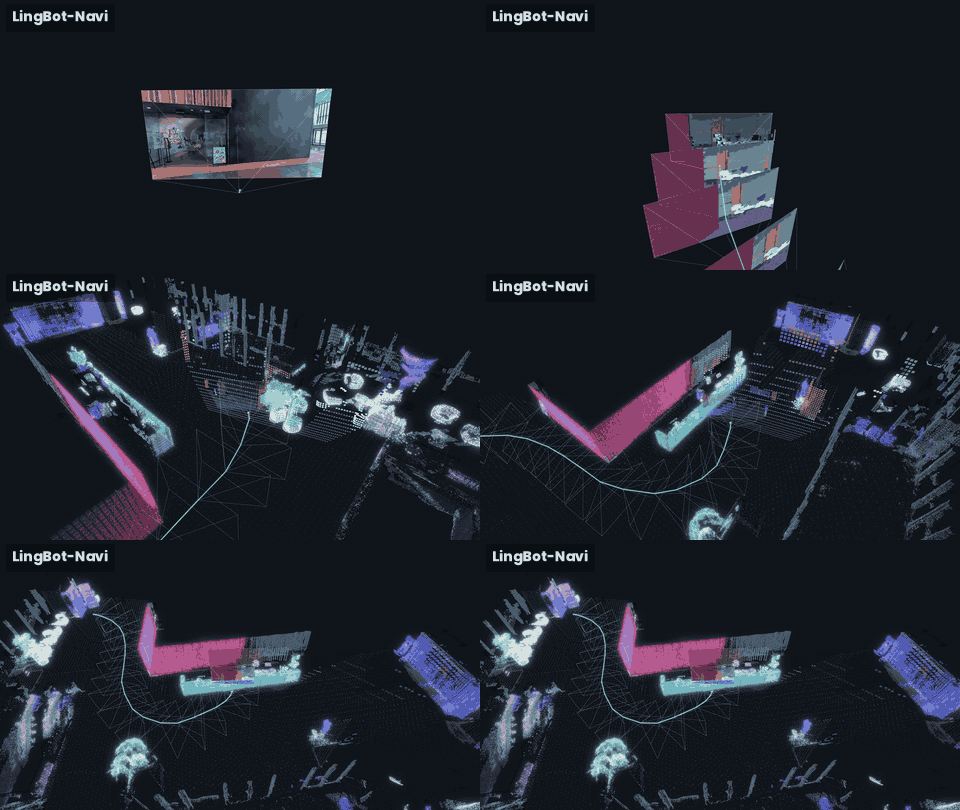
LingBot-Navi is designed for continuous operation in real environments. Unlike most navigation models that start from zero for each task and clear memory when a task ends, LingBot-Navi retains objects and locations seen during initial exploration and retrieves them for later tasks, reducing repeated exploration. Users can specify targets in natural language, add descriptions to distinguish similar objects and let the model continue exploring when existing memory is insufficient. The model can run locally on the robot, keeping site images and user instructions on device, the company said. It released a continuous-operation dataset from 511 real collection scenes and supporting evaluation cases.
In closed-loop simulation tests, LingBot-Navi achieved a 68.60% success rate on the same GOAT-Bench subset in target-selection tests, 10.36 percentage points above the highest of six compared methods. In end-to-end tests where the model planned routes and directly drove movement, success rates were 56.09% on GOAT-Bench and 32.36% on Robbyant’s internal evaluation set. SPL, a path-length-weighted success metric, reached 38.04% and 26.35%, up 1.42 and 16.84 percentage points versus the best baselines. Compared with a navigation agent equipped with GPT-6 Astra, LingBot-Navi posted success rates of 56.09% versus 51.97% on GOAT-Bench and 32.36% versus 26.67% on the internal set.
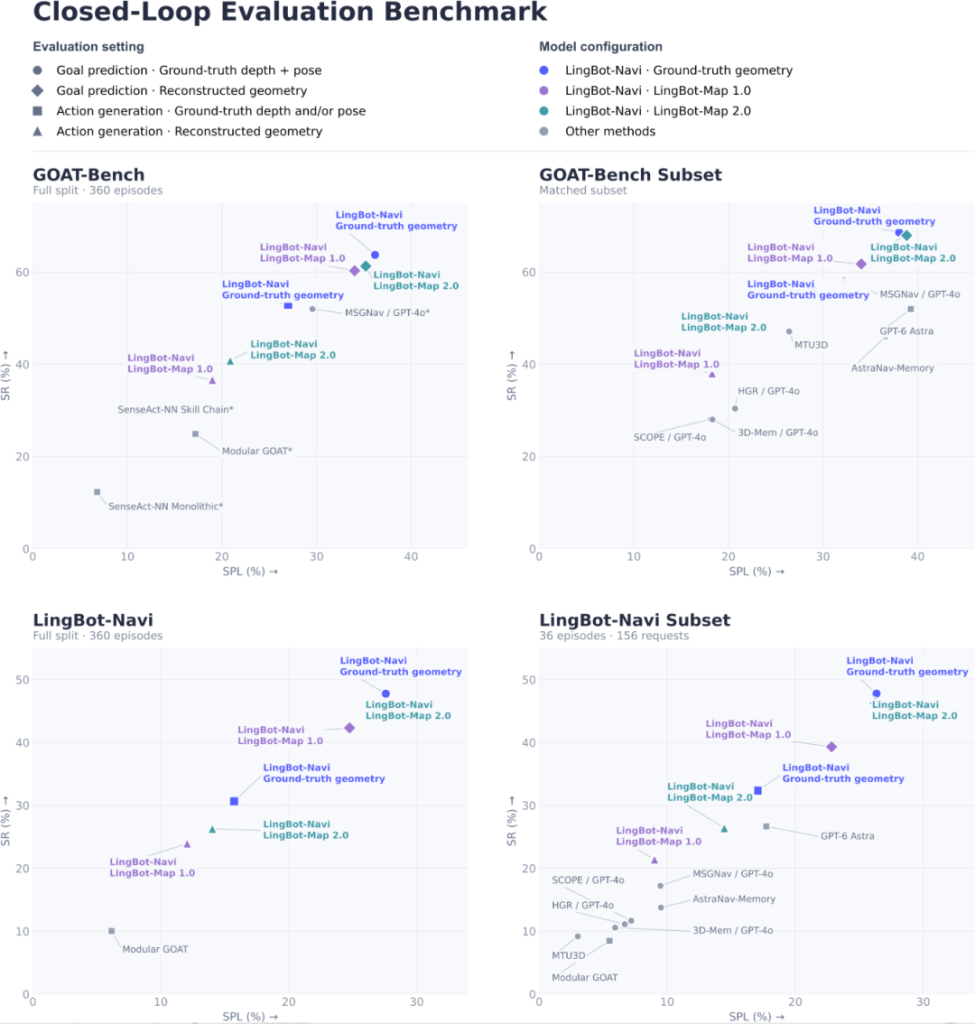
Robbyant said switching the underlying reconstruction model from LingBot-Map 1.0 to 2.0, without retraining LingBot-Navi, raised navigation success rates by 4.15 and 2.35 percentage points on the two evaluation sets and lifted SPL by 1.89 and 1.97 percentage points. The models, technical reports, code, model weights and dataset have been open-sourced, the company said.
LingBot-Map 2.0
Project page: https://technology.robbyant.com/lingbot-map-v2
Code repository: https://github.com/Robbyant/lingbot-map-v2
Technical report: https://github.com/Robbyant/lingbot-map-v2/blob/main/docs/lingbot-map-v2_paper.pdf
Model weights: https://huggingface.co/collections/robbyant/lingbot-map-v2 ; https://modelscope.cn/models/Robbyant/lingbot-map-v2
LingBot-Navi
Project page: https://technology.robbyant.com/lingbot-navi
Code repository: https://github.com/Robbyant/lingbot-navi
Technical report: https://github.com/Robbyant/lingbot-navi/blob/main/tech_report/Scene-aware%20Navigation%20with%20Spatial%20Memory.pdf
Model weights: https://huggingface.co/robbyant/lingbot-navi ; https://www.modelscope.cn/models/Robbyant/lingbot-navi
Dataset: https://huggingface.co/datasets/robbyant/LingBot-Navi ; https://www.modelscope.cn/datasets/Robbyant/LingBot-Navi

 AGIBOT
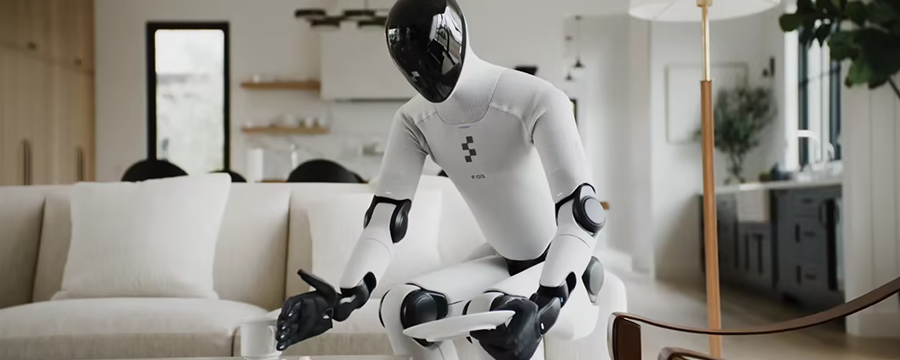 Figure AI
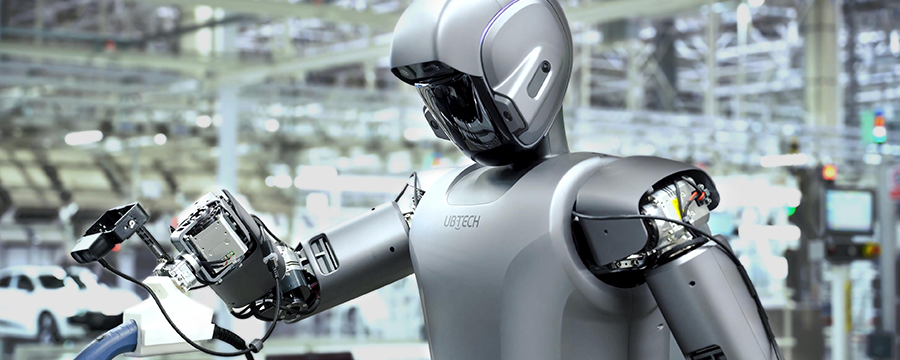 UBTECH