
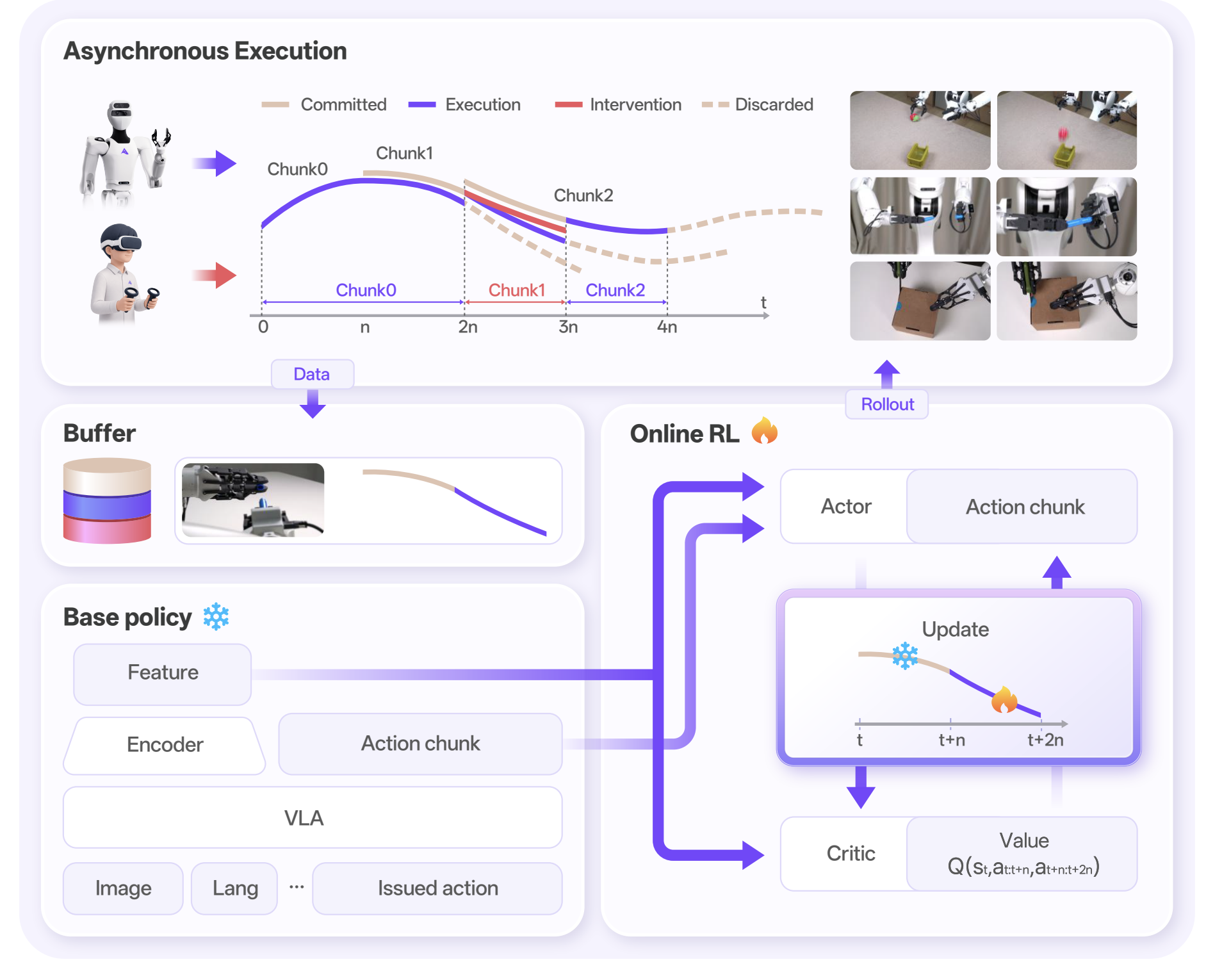
Astribot, a Chinese robotics startup, has unveiled SmoothRL, an online reinforcement learning framework designed to train policies during asynchronous execution – a growing reality for embodied AI deployments where inference and action run at different frequencies. The work, led by the company’s foundation model team, addresses a fundamental mismatch: when a robot receives new action chunks before previous ones finish, conventional RL that updates on entire chunks ends up crediting or blaming actions that were never actually executed. The framework partitions each action chunk into three regions – committed (already fixed), execution (actually performed), and discarded (overwritten by later inference) – and backpropagates gradients only through the execution region. This ensures that optimisation mirrors the robot’s real experience. SmoothRL also...
Fei-Fei Li’s startup World Labs has released Atlas, a next-generation world model billed as the first multimodal system capable of pixel-level camera-controllable image and video generation paired with native 3D scene reconstruction. Trained from scratch on text, image, video and 3D data, the so-called “omni model” unifies four distinct modalities within a single unified architecture. Its flagship innovation, termed “spatial context”, grounds each input image in a precise 3D coordinate space with explicit camera pose parameters. By treating geometric camera controls as native inputs, Atlas eliminates reliance on textual prompts to describe camera motion, letting users specify exact viewing angles and trajectories to generate up to 1440p-resolution videos with a maximum one-minute duration. World Labs frames the upgrade as letting...
A research paper co-authored by Dobot, the Institute of Computing Technology of the Chinese Academy of Sciences, the Nanjing College of the University of Chinese Academy of Sciences, the Nanjing Information High-Speed Rail Research Institute, and two other CAS-affiliated schools has been accepted for publication at the Findings of EMNLP 2026, the top-tier international conference on computational linguistics and natural language processing, which will take place in Budapest from 24–29 October. The study, titled “Meta-Learning Where to Allocate Experts: Task-Conditioned Layer-Wise Compression for MoEs,” proposes a novel compression method for mixture-of-experts models, marking a collaborative research achievement among the Chinese academic and industrial partners.
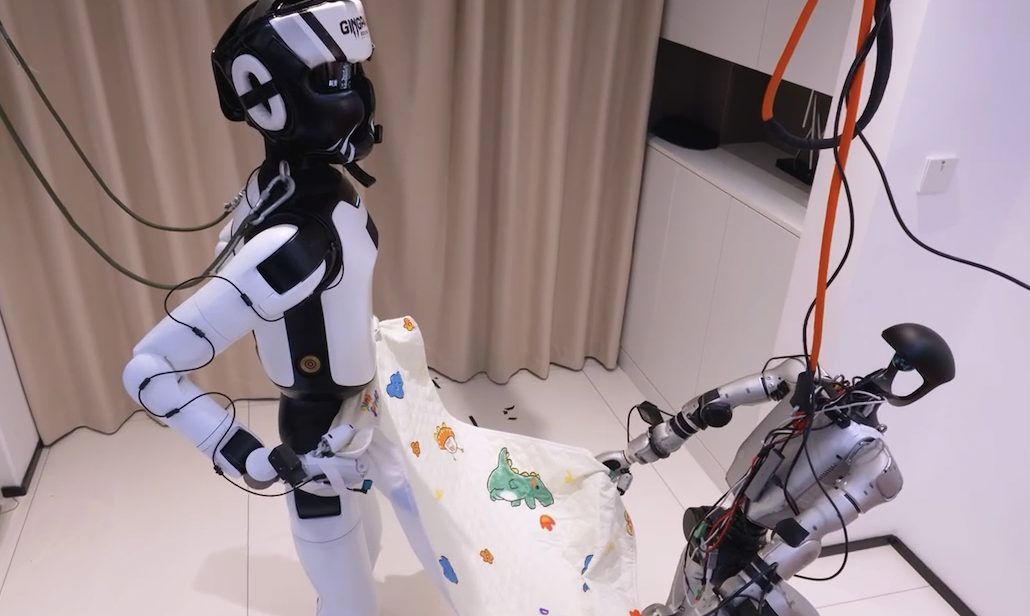
A mysterious Chinese artificial intelligence team has released a series of uncut, one-take videos showing humanoid robots performing household tasks with fluid, human-like coordination, reigniting online speculation that embodied intelligence might be nearing a “ChatGPT moment.” The clips, which went viral last week, depict robots adapting to external physical disturbances while carrying a water glass, tidying a living room in a single long-horizon sequence, collaborating to smooth a bedsheet, and carrying multiple items at once – all without visible teleoperation, according to the developers. The underlying model, internally codenamed MVP – short for “Make Veritable People” – is designed to endow machines with physical reasoning and autonomous decision-making rather than probabilistic imitation, the team said in response to inquiries. In...
OpenAI officially launched GPT‑6 Astra in the early hours of Wednesday, a name derived from the Latin word for “star”, following its prior teaser line “The stars are almost aligned”. At the close of the launch event, OpenAI president Greg Brockman stated “Welcome to the AGI era”, an unusually bold claim rarely voiced by an AI developer for its product. The new model delivers sweeping gains across leading evaluation benchmarks.
Suzhou Gongzhi Marine Equipment Technology Co., Ltd., a developer of underwater robotics, has closed an angel financing round of nearly 100 million yuan with joint investment from Zhongxin Zhidi, Lihe Finance, Yinfeng Capital and HEU Asset Management. The proceeds will fund product iteration and mass production, order delivery and market expansion, R&D and patent deployment, plus recruitment and development of top‑tier technical specialists and management talent.
Maniformer on Aug 31 rolled out its 20,000th MEgo untethered data‑collection unit, the industry’s first mass‑production milestone, while also surpassing 1 million hours of high‑quality untethered data, making it the first data‑service provider to commercially sell such a dataset at that scale.
Ant’s Lingbo Lab launches Zero-WAM robotics model, which learns tasks from human demonstration videos without task-specific training. It hit 46.95% average success on 7 unseen RoboTwin 2.0 tasks, beating baseline LingBot-VA by 29.5 percentage points. Dataset HumanGen pairs 74,200 human videos with robot trajectories across 8,600 tasks.
Investment in China’s embodied-artificial-intelligence sector reached 93.5 billion yuan in the first half of 2026, up five times year-on-year, while deal count soared 137% to 322 transactions, signaling sustained investor appetite. Monthly funding activity remained fairly steady, with March and June each recording over 60 deals. Three hubs – Beijing, Guangdong and Shanghai – captured 71% of all transactions and 79% of total value. Beijing topped the list with 100 deals worth 35.5 billion yuan, followed by Shenzhen (61 deals, 23.8 billion) and Hangzhou (34 deals, 9.2 billion). Suzhou and Wuxi also drew significant hardware-production projects, reinforcing the strong cluster effect in the Yangtze River Delta.
A humanoid robot manufacturing facility built through cooperation between Serbia, AgiBot Innovation (Shanghai) Technology Co., Ltd. (AgiBot), and Minth Group has officially commenced mass production in Šabac, with Serbian President Aleksandar Vučić attending the launch ceremony. Vučić toured production workshops and product exhibition halls, and interacted on‑site with humanoid robot units.

 AGIBOT