Chinese embodied AI startup PHANES AI, in partnership with Tinno Mobile, launched SeePhys Hub, a wearable full-body multimodal data collection system for robot training.
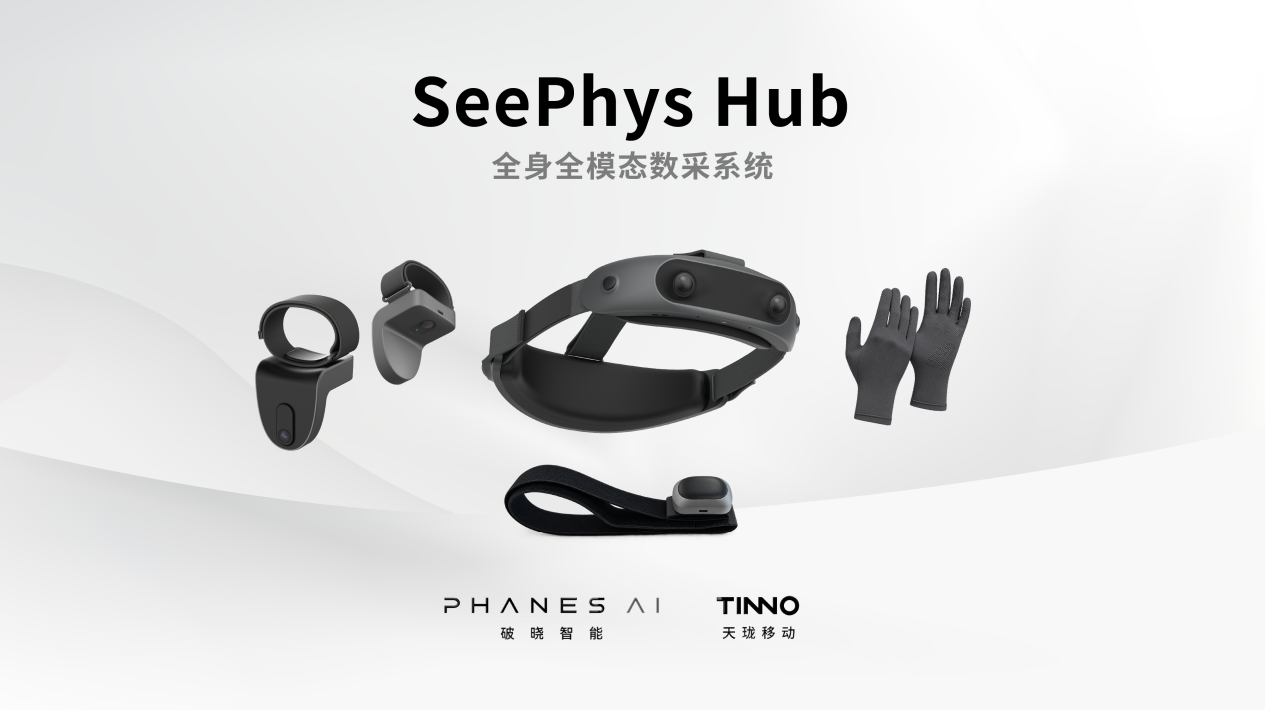
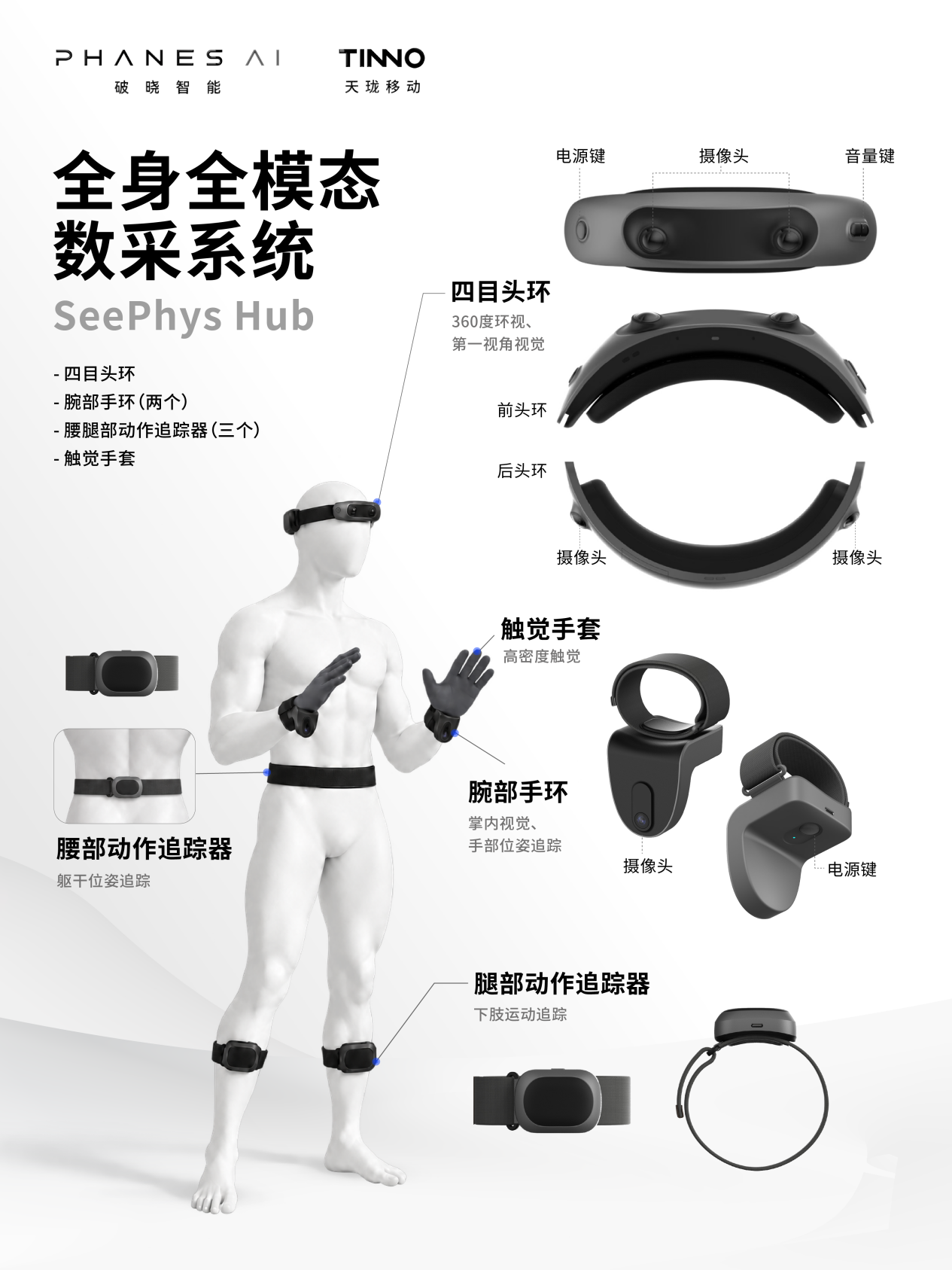
The system comprises a four-camera headband, two wrist bands, three waist-and-leg motion trackers and a tactile glove. PHANES said it can simultaneously collect first-person 360-degree visual data, full hand data including hand pose tracking and high-density touch, and full-body motion data including pose and force.
The launch comes as robot data collection has moved from teleoperation to UMI and Ego, with devices becoming lighter and collection simpler. But PHANES said that simplification has come at a cost: Ego can record what the hands are doing, but it struggles to fully capture whole-body movement and cannot sense pressure when hands contact objects. Those missing interaction signals are often central to completing a task.
SeePhys Hub is designed to retain the portability of Ego while adding back key body and contact data. A self-developed data processing platform converts human data into multimodal training data for robot learning.
The system is the first engineering product from the team’s EgoTouch, TouchAnything and TouchWorld research line. EgoTouch synchronizes first-person video, hand pose and pressure distribution. TouchAnything learns to estimate contact location and pressure from vision. TouchWorld brings touch into robot action, predicting contact targets before manipulation and correcting actions based on real feedback during execution.
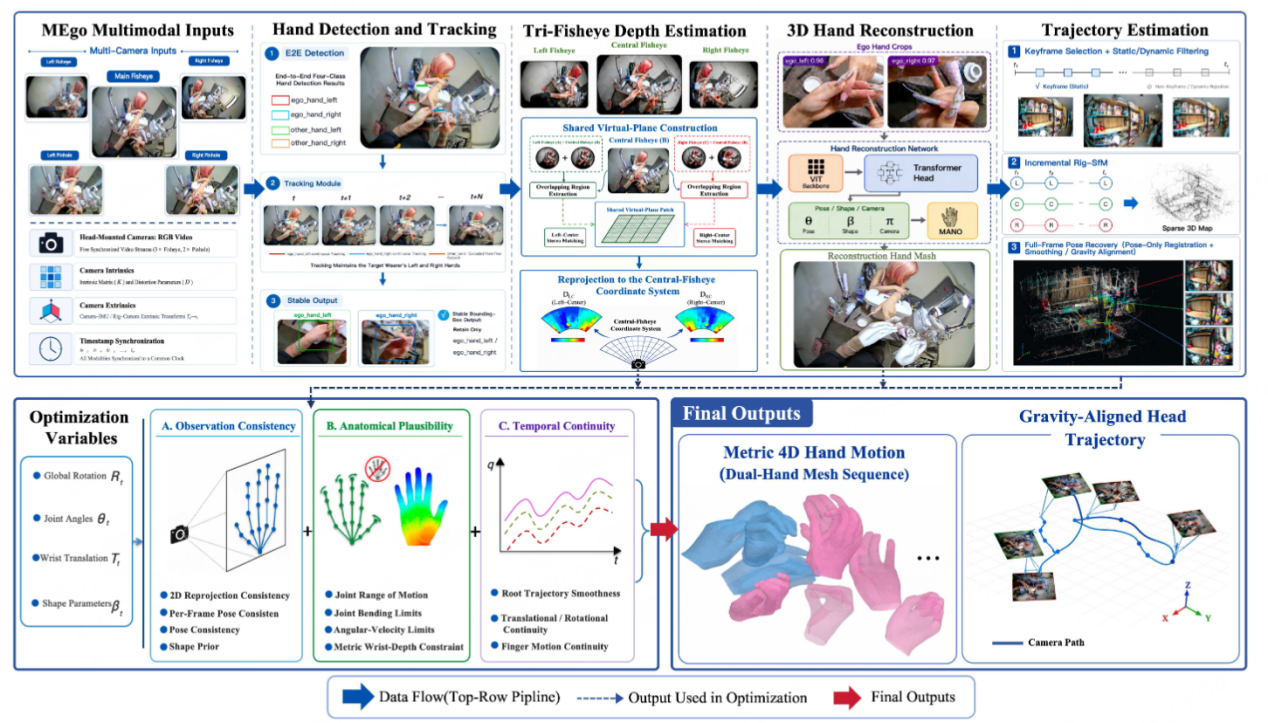
SeePhys Hub turns that work into a wearable collection system. The headset records scenes with four cameras, wrist views capture close-range manipulation details, waist and calf trackers record body movement, and tactile gloves collect hand contact pressure. Environmental observation, body motion and hand interaction are synchronized in a single operation record.
The headband weighs no more than 220 grams, and each wrist band no more than 75 grams. Both support up to 24 hours of continuous collection. Synchronization accuracy among cameras, IMU and UWB in the headband is within 0.5 milliseconds, helping align visual and motion information at the same moment.
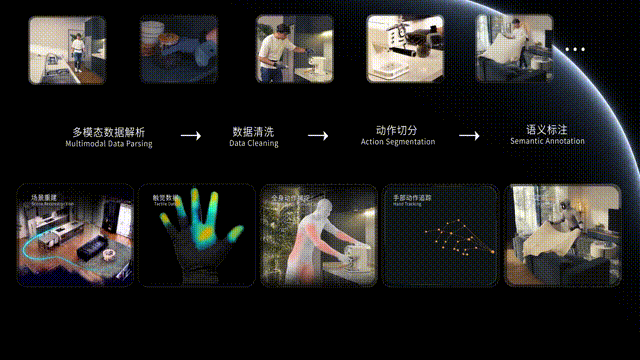
After hardware captures data, the self-developed platform parses and cleans raw data, segments continuous operations into action clips and adds semantic labels. It also connects scene reconstruction, full-body pose estimation and hand motion tracking. Motion retargeting maps human motion to a robot body to support later policy training and hardware adaptation.
PHANES said data volume alone does not directly equal learning gains. Researchers have estimated that 100 million hours of Ego data may be needed. But data quality, matching with robot tasks and training methods also affect results. The company wants to test whether synchronized whole-body motion and touch, alongside vision, can raise the learning value of each hour and allow million-hour-scale multimodal data to support expected generalization.
It cited bed-making as an example. A person must grip a sheet corner, lift and spread the sheet, then move along the bed and smooth wrinkles. Body position determines what the hands can reach, while grip location and force affect how the fabric unfolds. Vision-heavy Ego data can record the immediate operation but cannot fully capture torso and leg movement outside the field of view, or directly measure contact pressure during gripping and pulling.
The company’s longer-term goal is to build a world model for whole-body mobile dexterous manipulation, jointly modeling body movement, hand contact and environmental change. It wants the model to predict outcomes when a robot moves to a new position, adjusts posture or changes contact method, and to use execution feedback to correct judgments and choose next actions.
PHANES AI was founded by Yang Shuo, a tenured professor and doctoral supervisor at the School of Computer Science and Technology at Harbin Institute of Technology (Shenzhen). More than 90% of its core team members graduated from Tsinghua University, Peking University, the University of Hong Kong, Harbin Institute of Technology and other top universities, according to the company. Its members cover multimodal large models, world models, large-scale data processing and hardware.
The team says it wants to explore a native path for embodied AI: letting robots learn from real interaction and act autonomously in the physical world. SeePhys Hub marks a step from research toward product.

 the 2026 Bund Summit