DexForce, an Chinese embodied-AI developer, has unveiled UNITAS, a 3D-native world action model for robot manipulation, saying it is designed to give robots a unified representation of the physical world. The company described UNITAS as the first robot-task-native 3D world model.
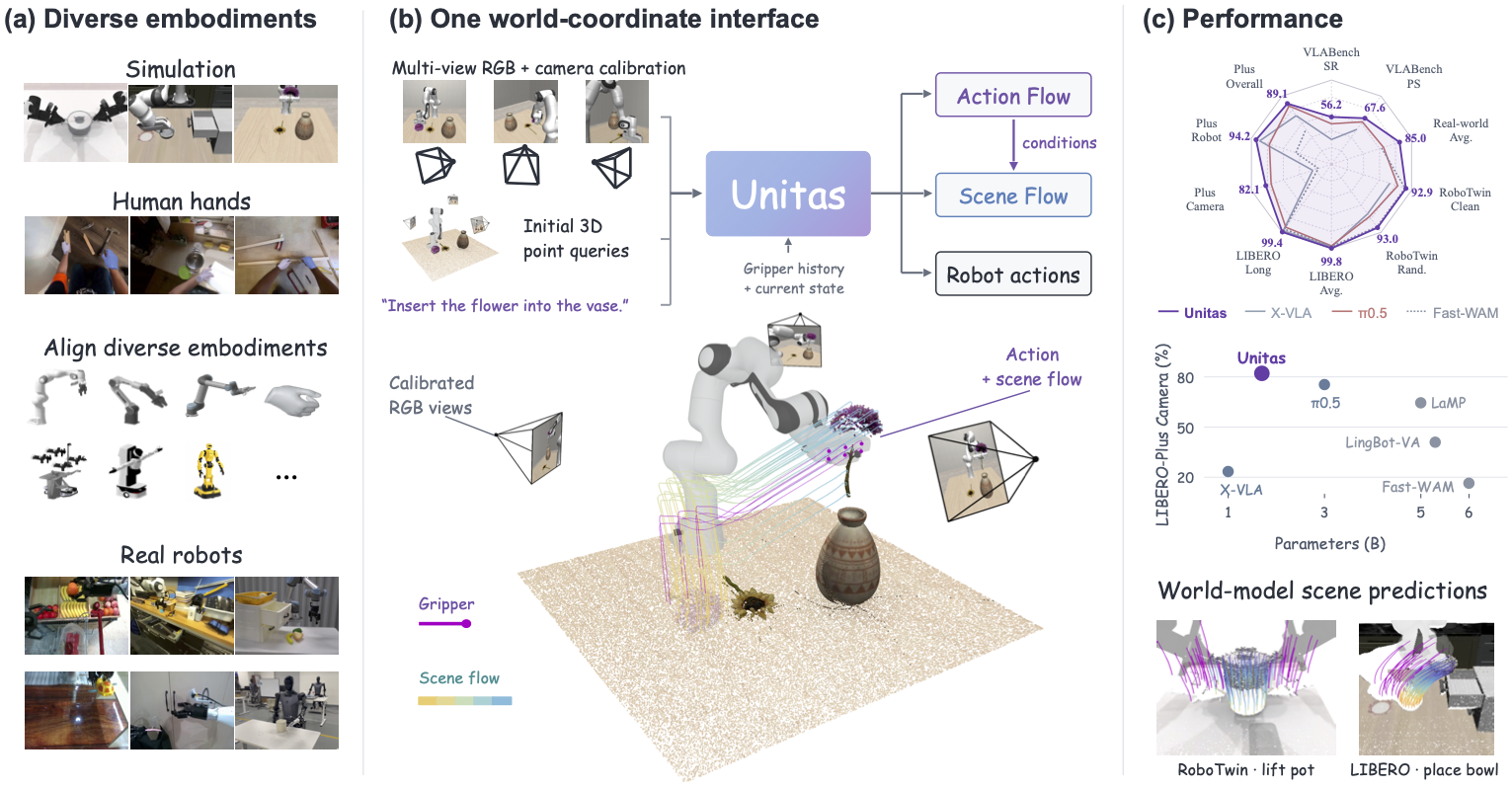
UNITAS is built on a central premise: just as large language models unify diverse knowledge through text, embodied AI needs a native space for physical experience. DexForce argues that space should be the 3D physical world itself, rather than 2D images or latent features from which 3D relationships must be inferred.
The model jointly represents observation, action and scene change in a single 3D coordinate system. Observation corresponds to the 3D positions of objects; action flow corresponds to the trajectories of robot end-effectors or human hands; and scene flow corresponds to how objects move after an action. The backbone, Point Dynamics DiT, processes 3D tokens directly instead of using image tokens as an intermediary.
DexForce said UNITAS, with only 1.7 billion parameters, achieved a 99.8% average success rate on LIBERO, 99.4% on LIBERO-Long and 89.1% on LIBERO-Plus. On RoboTwin 2.0 dual-arm manipulation, it reported 92.94% success in the Clean setting and 93.04% in the Randomized setting.
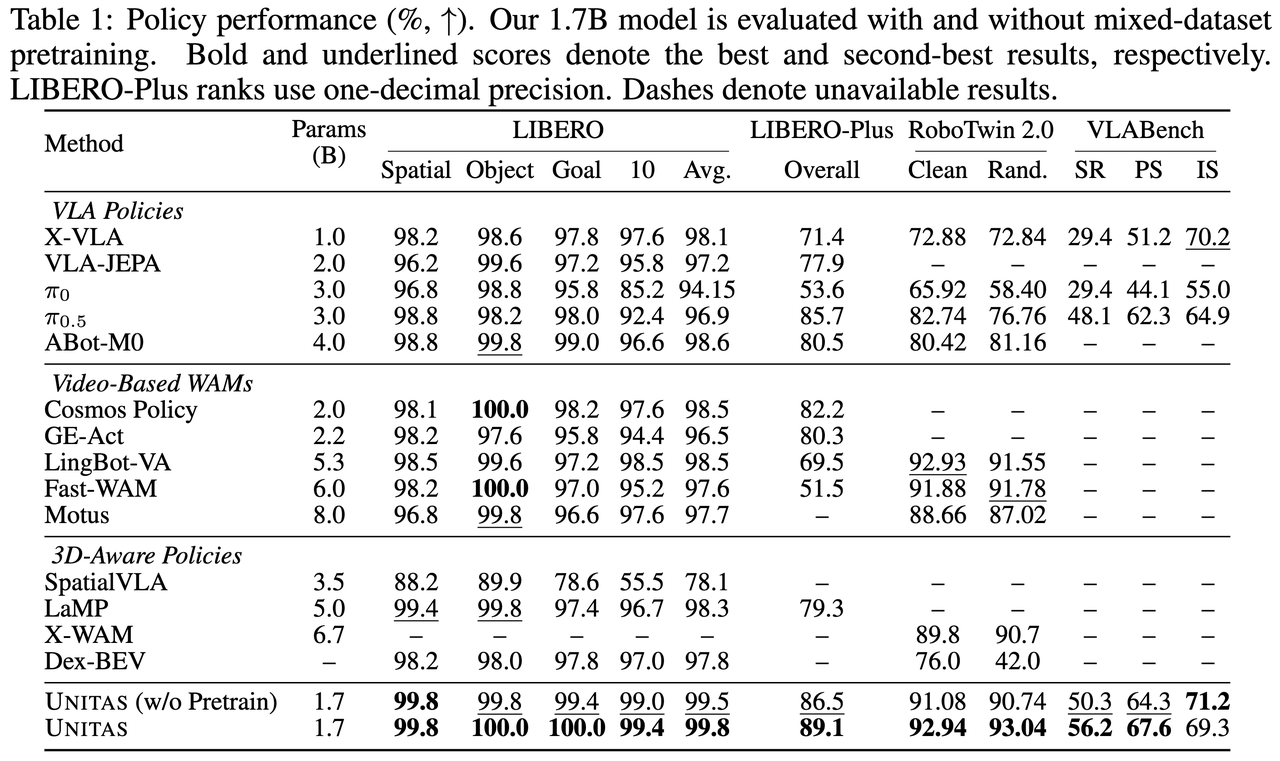
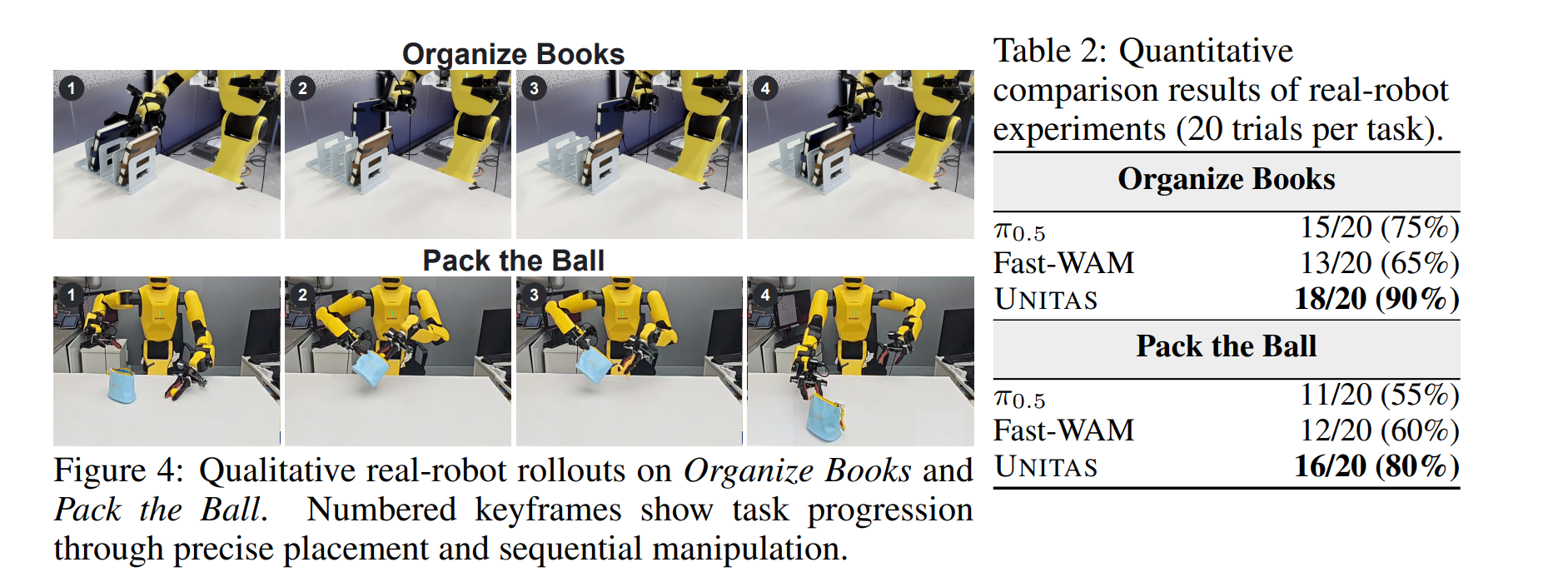
The company said those results surpassed larger models including Fast-WAM at 6 billion parameters, Motus at 8 billion parameters, as well as π0.5, LingBot-VA and PointWorld. In real-robot tests, UNITAS recorded an average success rate of 85%, including 90% on Organize Books and 80% on Pack the Ball.
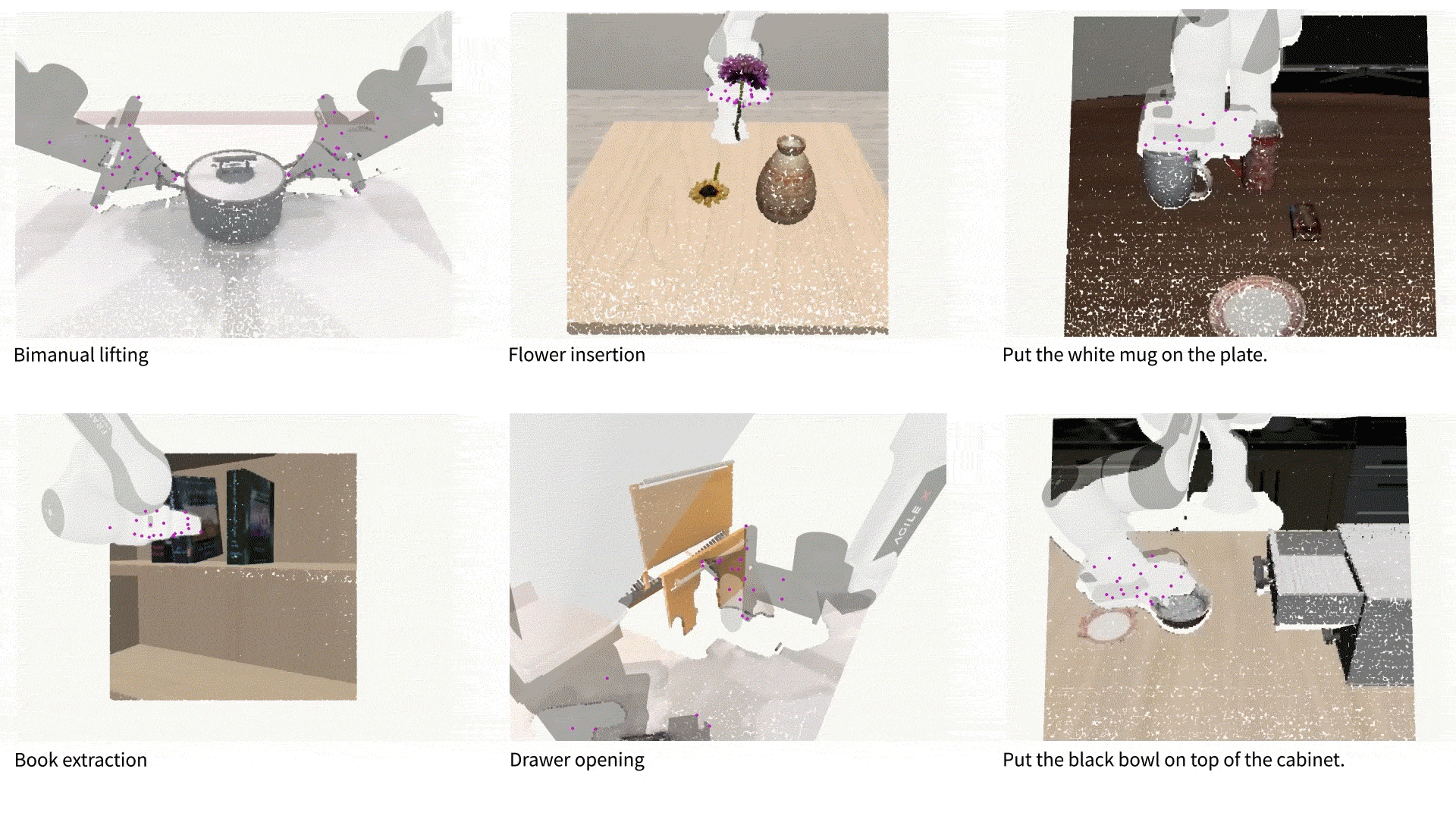
For action-conditioned scene prediction, DexForce reported that UNITAS reduced average moving trajectory error to 0.427 cm from PointWorld’s 0.656 cm, a decline of about 35%. It said 92.31% of predictions were within 1 cm of the actual outcome, leading on all four scene-prediction metrics in the RoboTwin simulation test.
UNITAS also seeks to address data heterogeneity in robotics. Robotic data comes from simulation, real machines and human demonstrations, while different robots have different hardware and control systems. The model converts human hands, robot grippers and simulated end-effectors into point trajectories in 3D space, allowing data from different sources to be trained in a common representation.
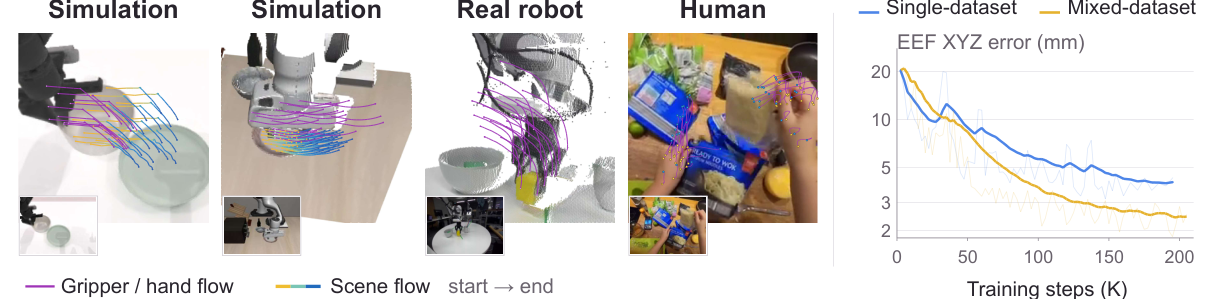
DexForce said it mixed nine data sources for pretraining and then fine-tuned the model for specific tasks. On LIBERO-Plus, mixed pretraining improved overall success by 2.6 percentage points. Under robot initial-state perturbations, success rose to 94.2% from 84.8%.
To handle inconsistencies across datasets, UNITAS uses a World-Aligned 3D Position Embedding, which maps observations, action flow and scene flow into a unified 3D coordinate encoding. It can also learn to complete depth within the viewing frustum, allowing the model to adapt to both RGB-D and RGB data.
A Physical Time Trajectory Encoder converts trajectories with different sampling rates and durations into a unified feature space. The model operates in two modes: a policy mode that generates executable actions from task goals, and a simulator mode that predicts how a scene will change given an action trajectory.
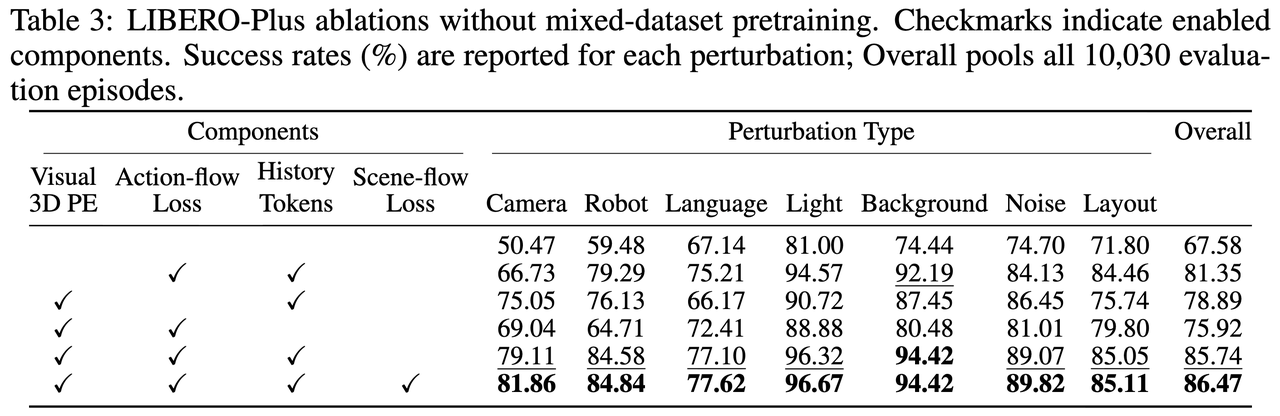
Ablation experiments showed that removing three 3D-native components—3D position encoding, action flow supervision and action flow history tokens—reduced the model to a conventional VLA baseline, cutting overall success to 67.58% from 86.47%. DexForce said each component contributes to performance: 3D position encoding supports cross-view generalization, action flow supervision aligns observation and action spaces, action flow history tokens improve robustness to initial-state changes, and scene flow supervision helps the model understand how the world changes after an action.
DexForce has also developed the DexVerse generative simulation engine and the EmbodiChain embodied-AI toolchain. The company said these systems form a data loop of simulation generation, model learning, real-world validation and data feedback. It added that UNITAS can predict reasonable scene changes from real-world DROID and RH20T observations using only gripper trajectories, even though its scene-flow supervision comes mainly from simulation data.
The paper: https://arxiv.org/abs/2610.12099
The project page: https://dexforce.com/technical-report/#/unitas-wam
The open-source code: https://github.com/DexForce/UNITAS


 the 2026 Bund Summit