
U.S. humanoid robot maker Figure AI released a video on Sept. 30 showing several retired Figure 02 robots jumping into molten steel, in a farewell staged with “Terminator” star Arnold Schwarzenegger and intended to mark the company’s shift to newer models. The company said the footage was not AI-generated. It trained the robots to jump, shipped them to Finland and placed them into molten metal. In the video, multiple Figure 02 robots stand at the edge of a furnace, look into the molten steel, back away, run and leap in. Another robot is lowered by chain and raises a mechanical thumb before being submerged. Schwarzenegger, who starred in “Terminator 2: Judgment Day,” took part and said: “Hasta la vista, Figure...
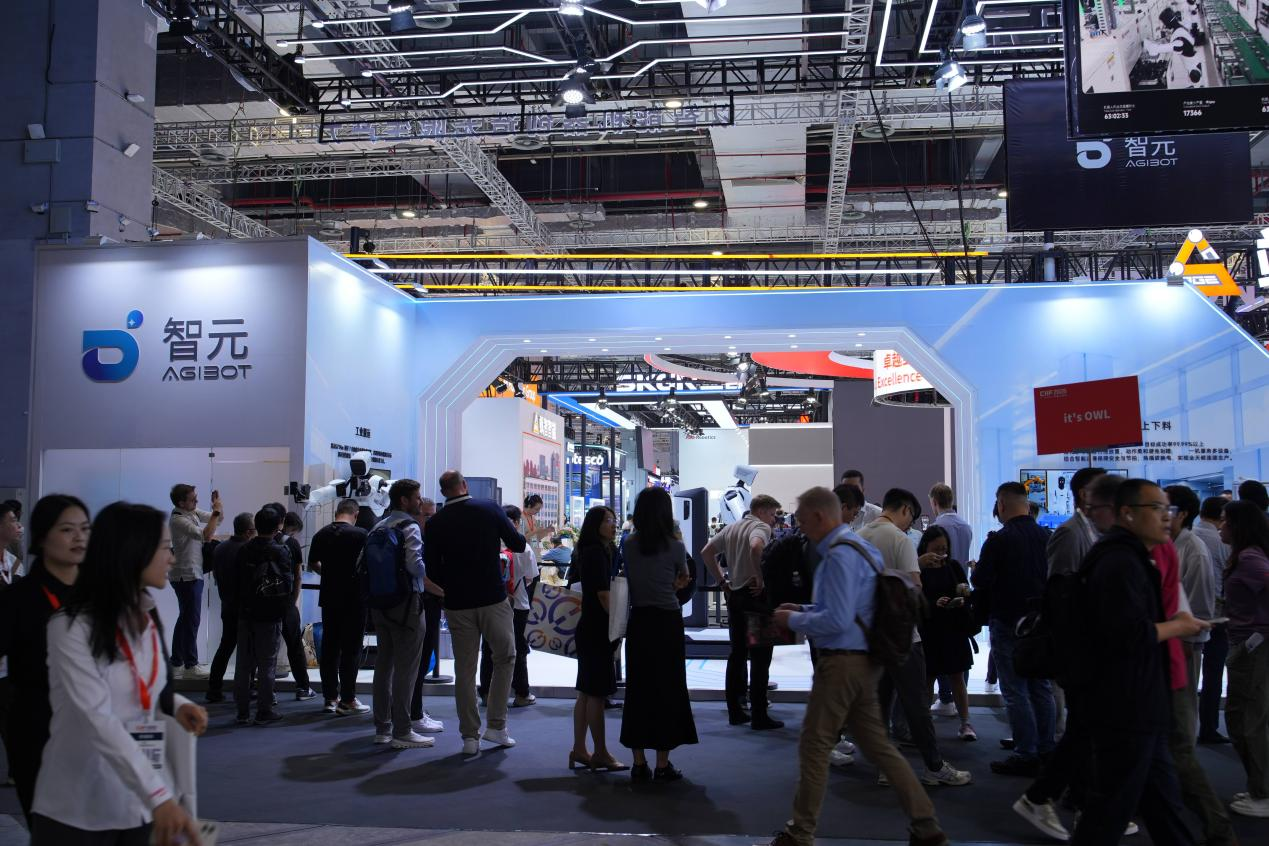
China’s AGIBOT showcased humanoid robots performing real industrial tasks at the 26th China International Industry Fair on Monday, saying its AGIBOT G2 machines are moving from single-task trials to stable, scaled deployment. The Shanghai-based company organized its exhibit around “industrial deployment,” demonstrating autonomous work in precision manufacturing, flexible assembly, semiconductor packaging and testing, and warehouse logistics. It said the display covered the full chain from data and robot bodies to production-line deployment. In optical module insertion, AGIBOT said the G2 used high-precision force-controlled arms, joint torque sensors and an in-house real-machine reinforcement learning framework to handle sub-millimeter tasks and protect gold-plated contacts. Using its Genie Studio Agent platform, a full task deployment can be set up in two to three...
Chinese embodied AI startup Astribot has raised 1 billion yuan in a new funding round, valuing the rope-driven robot maker at 15 billion yuan. Toposcend Capital, a unit of Shenzhen Investment Holdings, led the round. Hongtai Fund, Ninghai Xingtaihe Fund managed by Guanghua Sunshine, Soliton Capital and existing shareholder Xianmu followed on. It was Astribot’s fourth round in six months. Its valuation rose from 10 billion yuan to 15 billion yuan in three months, a rare pace even in China’s hot humanoid robot sector. Astribot said proceeds will fund model upgrades, hiring, commercial deployment, capacity and its three-in-one full-stack architecture spanning an AI model, embodied operating system and rope-driven body. Founder and CEO Lai Jie said investors were important “fellow...
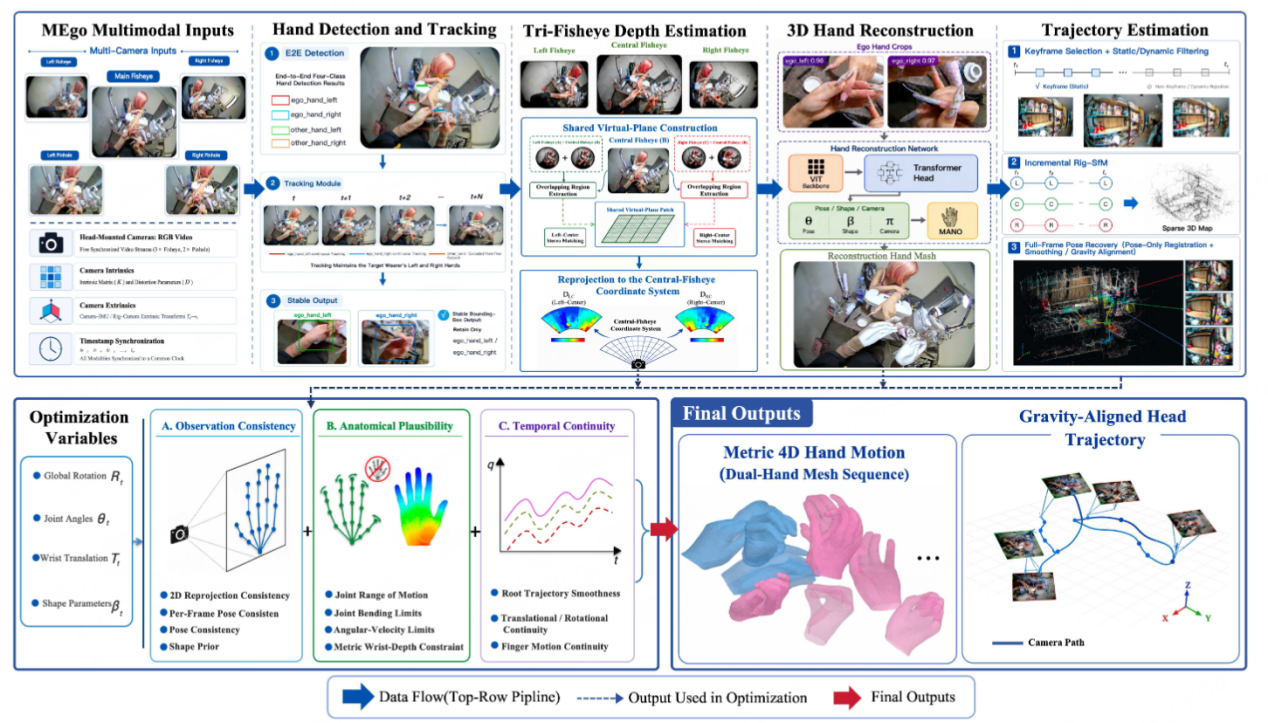
Chinese researchers said they have developed MEgoVista, a framework that converts first-person, or ego, video into 4D motion data for training embodied AI models, addressing a gap between the growing supply of ego video and the precise motion data robots need. The paper was produced by Maniformer Technology, Northwestern Polytechnical University and Xi’an Jiaotong University. Ego video has become an important source of pretraining data because it can be captured in homes, workplaces and other real environments rather than specialized laboratories. But recording an action does not automatically produce usable 4D data, meaning three-dimensional motion over time. Systems must identify the wearer’s hands, reconstruct finger poses and measure how far the hands move in space. MEgoVista is designed as an...
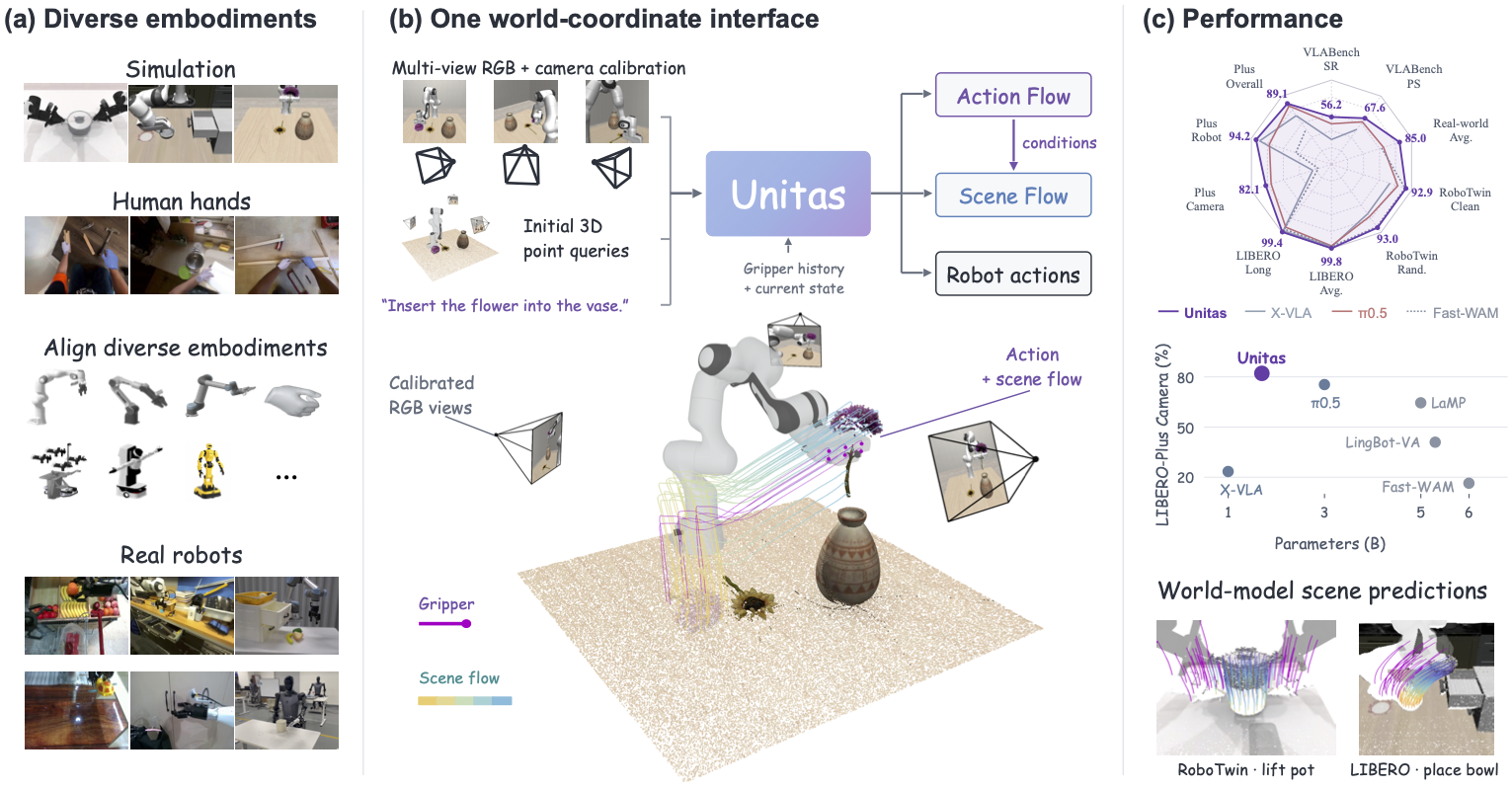
DexForce, an Chinese embodied-AI developer, has unveiled UNITAS, a 3D-native world action model for robot manipulation, saying it is designed to give robots a unified representation of the physical world. The company described UNITAS as the first robot-task-native 3D world model. UNITAS is built on a central premise: just as large language models unify diverse knowledge through text, embodied AI needs a native space for physical experience. DexForce argues that space should be the 3D physical world itself, rather than 2D images or latent features from which 3D relationships must be inferred. The model jointly represents observation, action and scene change in a single 3D coordinate system. Observation corresponds to the 3D positions of objects; action flow corresponds to the...
Ola Dimensions, a Chinese startup focused on home embodied intelligence, said it has completed an angel-plus funding round worth several hundred million yuan. The round was co-invested by new and existing shareholders including Chengyuanxiang Fund, Xinneng Venture Capital, Xizhou International, Topband and Hony Capital. Founded in March 2026, Ola Dimensions aims to develop deployable embodied intelligence for the home and build home robots that can learn and grow, the company said. Its founder, Zhou Shunbo, is a Huawei “Genius Youth” recruit in robotics.
UBTECH Robotics ranked 11th with a total score of 115 on the 2026 Fortune Future 120 list, jointly released by Fortune and Boston Consulting Group (BCG), making it the highest-ranked Chinese company on the list. The list, which focuses on companies’ organic growth vitality, selected 120 companies from more than 3,500 globally based on three dimensions: growth ambition, talent density and growth culture. U.S. tech giants on the list included Nvidia at No. 16, OpenAI at No. 18, Apple at No. 55, Tesla at No. 87 and Meta at No. 120. Eleven Chinese companies were selected. UBTECH said its first-half 2026 revenue was 1.27 billion yuan, up 104.2% year on year. Overall humanoid robot sales volume rose 268.3%. Revenue from...
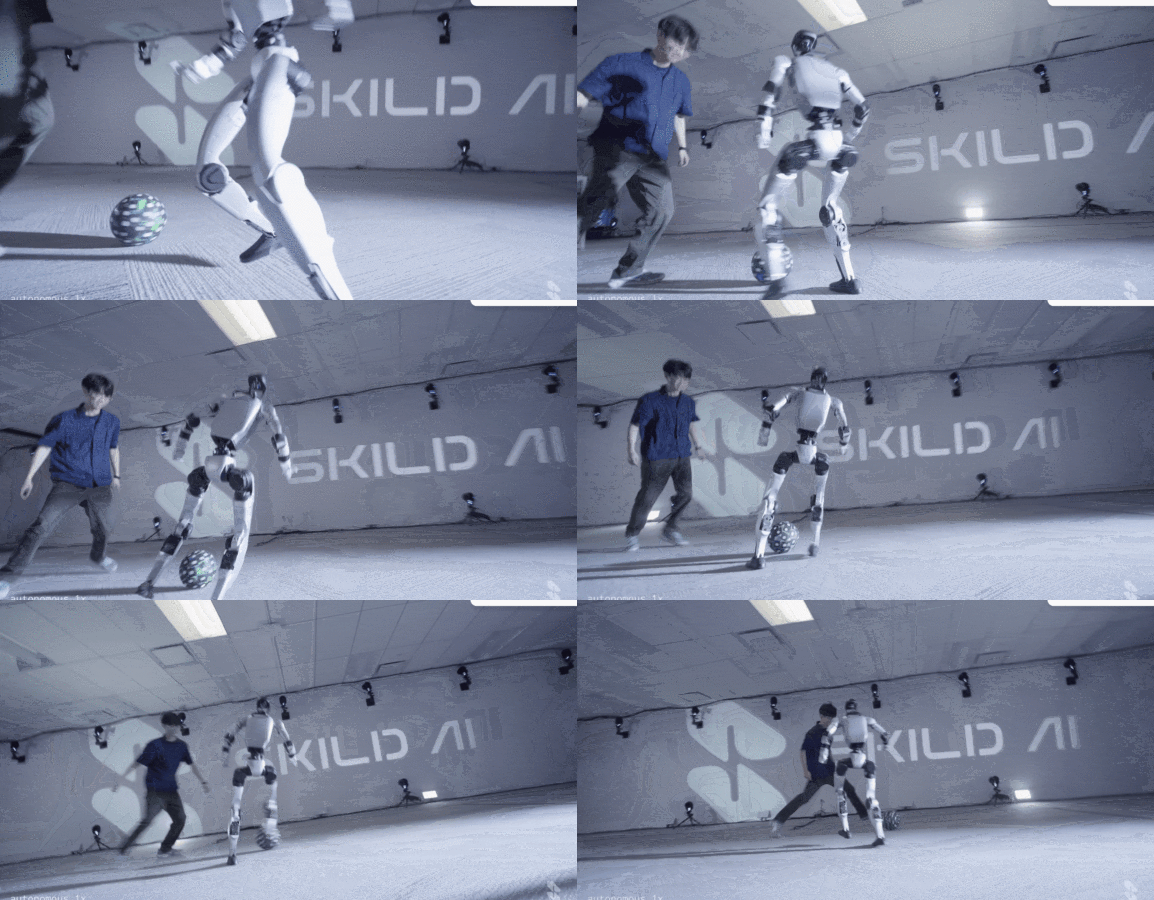
Skild AI has unveiled a new post-training approach for embodied intelligence that uses physical self-play to teach humanoid robots highly dynamic skills. In a demonstration centered on soccer, the company showed a robot defending, dribbling past opponents and scoring—abilities acquired largely through self-competition rather than hand-coded rewards. The robot tracks the ball closely and denies the human opponent possession. After briefly losing focus and conceding an interception, it recovers, turns, runs with the ball and finishes into the goal. The significance is not robot soccer itself, but the use of physical self-play. Most robot foundation models are pretrained on human data. Skild’s S1 model, released last month, follows that pattern and can learn tasks from in-context demonstrations, similar to prompt-based...
The global market value of industrial robot installations has reached an all-time high of $16.7 billion, according to the International Federation of Robotics, or IFR. The Frankfurt, Germany-based organization predicted that a number of technological innovations, market forces, and new fields of business will drive future demand. Here are the top five trends the IFR identified for the robotics industry in 2026. 1. AI gives robots greater autonomy Robots that use artificial intelligence to work independently are becoming more common. The main benefit of AI in this context is the increased autonomy of robots empowered by AI. Different types of AI drive this trend: Analytical AI helps to process large datasets, detect patterns, and provide actionable insights. For example, it...
Chinese AI startup Mosi Intelligence said it has raised more than 1 billion yuan ($140 million) in a pre-A funding round led by Huakong Fund. Investors included CDB Sci-Tech Innovation, Shanghai Sci-Tech Innovation Fund, Xinwei Capital, Xuhui Capital, Zhuiguang Hard Tech Venture Capital and Lingang Ceyuan Fund, among others. Existing shareholders Oriza Holdings, Shanghai Sci-Tech Group under Shanghai State-owned Investment, and Xinglian Capital also participated. Duowei Capital served as exclusive financial adviser for the round and on a long-term basis. Mosi Intelligence said the proceeds will be used to advance R&D and capability building for omni-modal real-time interactive intelligence, as well as global commercialization. After the round, the company will continue to bet on omni-modal real-time interactive intelligence and “AI...


 the 2026 Bund Summit