Skild AI has unveiled a new post-training approach for embodied intelligence that uses physical self-play to teach humanoid robots highly dynamic skills. In a demonstration centered on soccer, the company showed a robot defending, dribbling past opponents and scoring—abilities acquired largely through self-competition rather than hand-coded rewards.
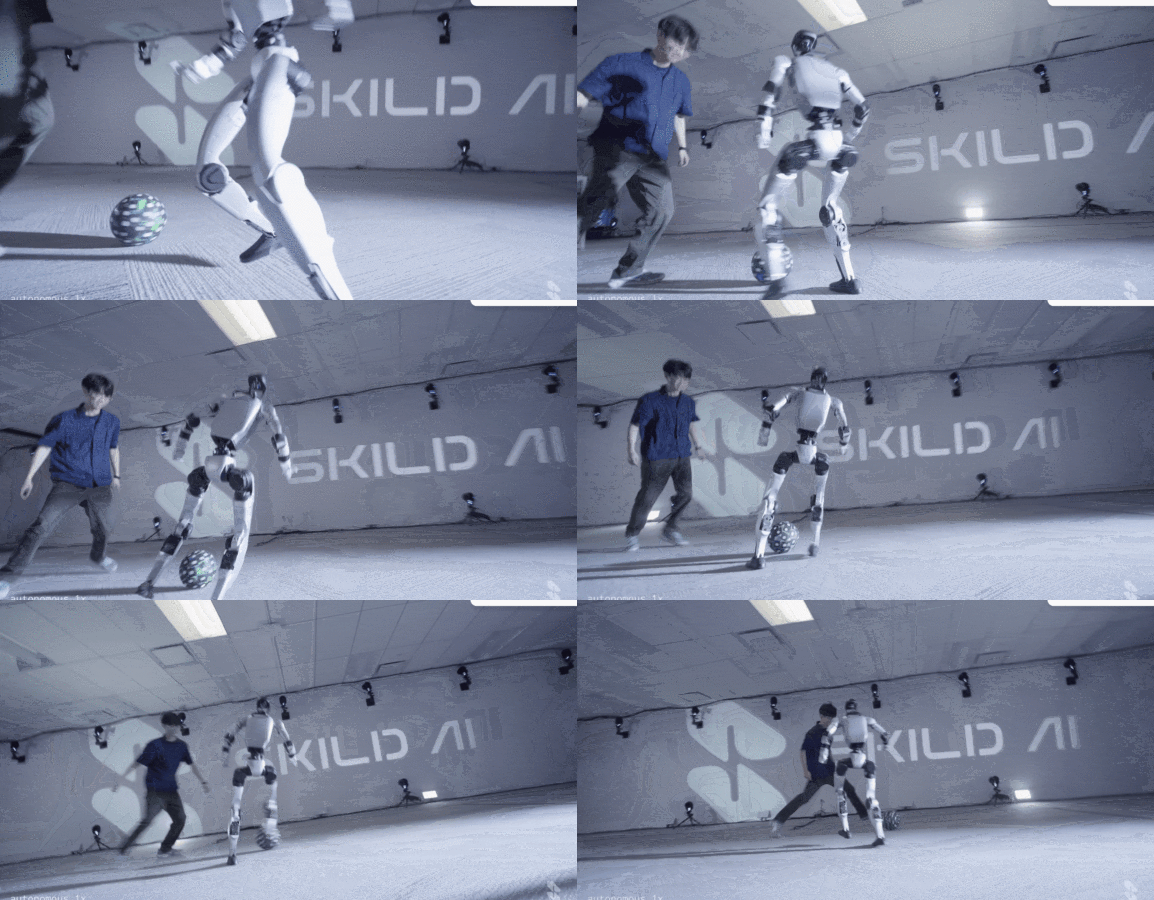
The robot tracks the ball closely and denies the human opponent possession. After briefly losing focus and conceding an interception, it recovers, turns, runs with the ball and finishes into the goal.
The significance is not robot soccer itself, but the use of physical self-play. Most robot foundation models are pretrained on human data. Skild’s S1 model, released last month, follows that pattern and can learn tasks from in-context demonstrations, similar to prompt-based learning in language models. That paradigm, however, confines robots to capabilities humans have already demonstrated.
Self-play offers an alternative. It allows AI to discover strategies not present in the original training data and to improve through continuous self-competition. In simulation, a robot can play against itself, sharpening its ability to dribble, defend and score. As its skill rises, it is matched against stronger versions of itself, eventually reaching human-level opposition and potentially exceeding it.
Skild says its results indicate that foundation models such as S1 can learn highly dexterous, dynamic tasks through this process. The team argues that physical self-play could enable robot foundation models to break through human capability ceilings.
Self-play has a deep history in AI. It was central to AlphaGo’s 2016 victory over Lee Sedol, including the celebrated Move 37, and to AlphaGo Zero’s 100-0 defeat of the original AlphaGo after only three days of self-play. It later scaled to multiplayer settings, with OpenAI Five beating world-champion-level Dota players in 2019. Interest subsequently shifted toward reinforcement learning from verifiable rewards, which is simpler and easier to deploy.
Skild’s robotics training uses a similarly sparse objective: score. The policy learns by playing against recent versions of itself, while opponent difficulty scales with its own progress. In NVIDIA Isaac Sim, the robot initially could not walk for months. It later learned to stand after falling, then acquired dribbling past defenders, shielding and tackling. None of these behaviors were manually rewarded; they emerged because they helped the robot score.
The company says the transfer from simulation to a humanoid robot, combined with the complexity of the task, points to self-play’s potential on the path to physical AGI.

 the 2026 Bund Summit