RoboScience’s machine science team has released WorldFlow, which it described as the world’s first native 3D dynamics prediction world model. The team said the system allows robots to interpret manipulation intent from a scene and a task instruction, imagine how objects should move in three-dimensional space, and use that prediction to support more accurate robot manipulation.

The team said robots still face two main challenges in predicting physical motion. Video generation models can produce realistic future frames from large video datasets, but 3D motion is implicit in 2D pixel changes and must be extracted through geometry reconstruction and motion tracking, which can introduce cumulative errors. Methods that skip video generation and directly predict 3D trajectories are more direct but lack visual signals from the physical world, limiting their ability to understand contact and interaction and to generalize.
WorldFlow treats 3D motion as an independent generation modality alongside video. Instead of extracting trajectories after generating video, the model jointly predicts future video and the target object’s 3D trajectory in a single generation process. Given an observation, a language instruction and a target object, WorldFlow can predict both the future video and the object’s 3D path. In one example from the paper, the instruction “pick up the black slipper and place it on the third shelf of the shoe rack” leads the model to preview the slipper being picked up, moved and placed, while directly predicting the 3D paths and final positions of points on the slipper.
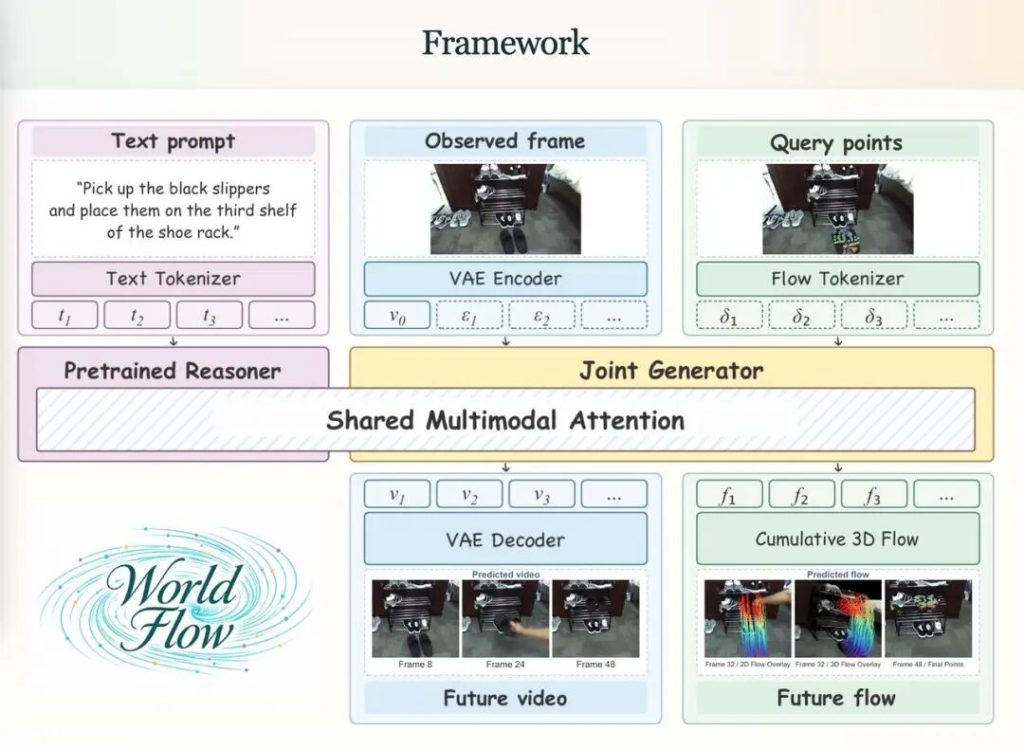
To link 2D images with 3D motion, the team designed two complementary encoding mechanisms: 3D point geometry encoding, which helps the model understand object positions and geometric relationships in 3D space, and spatio-temporal positional encoding, which links motion trajectories to video frames so the model can associate an object’s movement with the relevant visual region. In a Mixture of Transformer (MoT) architecture, video and motion exchange information through bidirectional attention and are denoised jointly. Video provides visual cues such as appearance, contact and occlusion, while 3D motion provides spatial displacement information.
The team built a data pipeline integrating 17 data sources from simulation, robot manipulation and human manipulation scenarios, constructing about 1.44 million training samples. Each sample contains an operation video under a task instruction and the manipulated object’s 3D motion trajectory, so the model learns both how the image should change and how the object should move. The team also built WorldFlowBench, a benchmark covering simulation, real-world and spatial cognition scenarios, and evaluated trajectory prediction accuracy using average displacement error (ADE) and final displacement error (FDE).
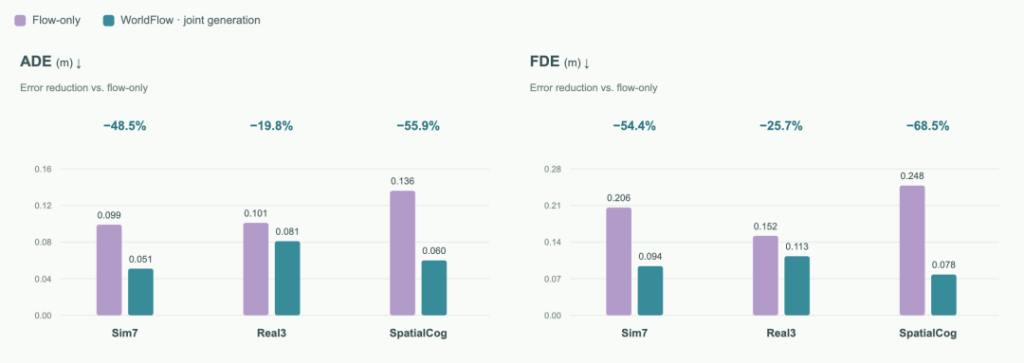
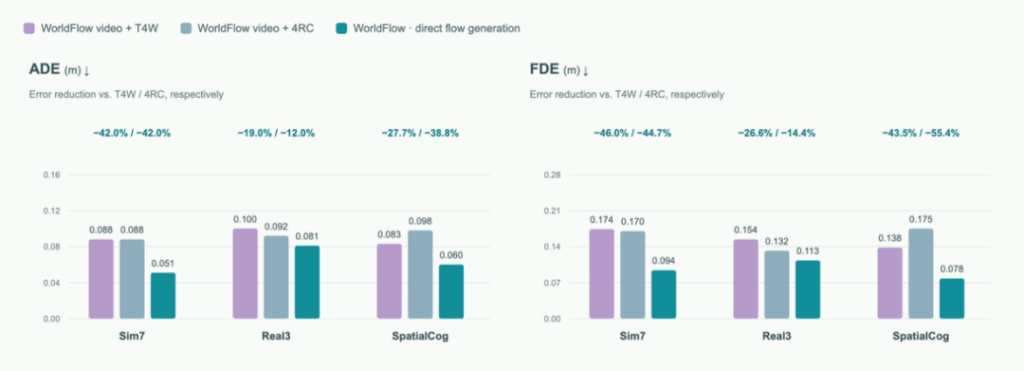
In ablation studies, adding video supervision improved 3D motion prediction compared with a variant that predicted only 3D motion under the same network architecture, training data and hyperparameters. ADE fell by 48.5%, 19.8% and 55.9% in simulation, real-world and spatial cognition scenarios, respectively, while FDE fell by 54.4%, 25.7% and 68.5%. Compared with two-stage approaches that first generate video and then track 3D trajectories using methods such as Track4World or 4RC, WorldFlow also performed better. Using Track4World as an example, ADE fell by 42.0%, 19.0% and 27.7%, and FDE fell by 46.0%, 26.6% and 43.5%, respectively.
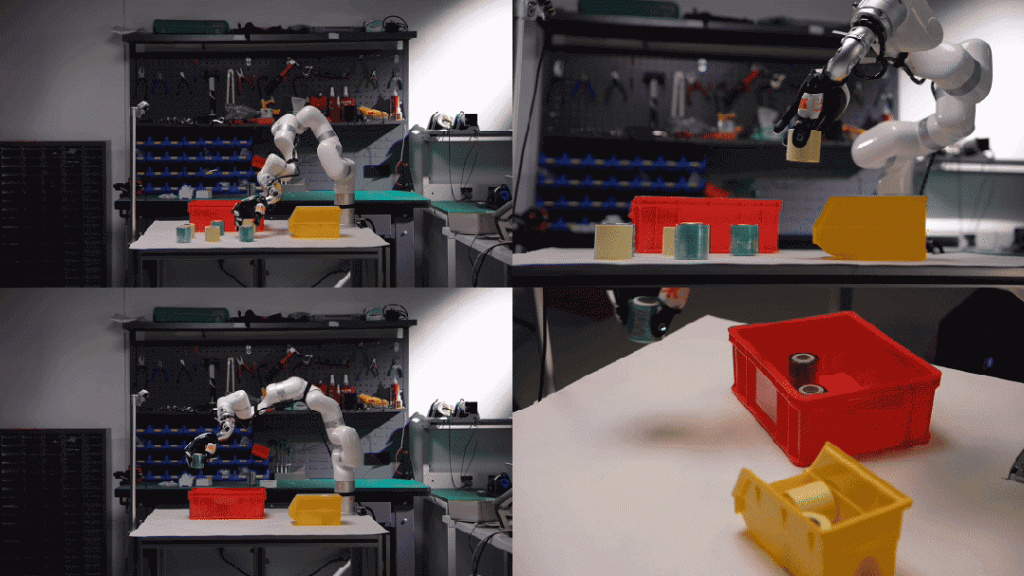
In real-robot experiments, the team compared WorldFlow with mu-zero, a leading motion prediction model, across 12 tasks covering pick-and-place, stacking and relative placement. Using the same grasp and control system, WorldFlow raised the probability of generating a correct trajectory from 25.0% to 97.2% and raised the real-robot operation success rate from 11.1% to 66.7%, the team said. The team said the approach could make 3D object trajectories a general planning interface across robot embodiments, allowing different robot forms to share object motion targets and complete tasks through their own control systems.
Paper: https://arxiv.org/abs/2610.39278
Project page: https://roboscience-ai.github.io/worldflow-page/


 AGIBOT
 Figure AI
 UBTECH