Maniformer, a Chinese physical-AI data platform, has published a paper on Ego-CEVR, a data-native hierarchical visual representation learning architecture that assigns different learning objectives to heterogeneous embodied data sources.
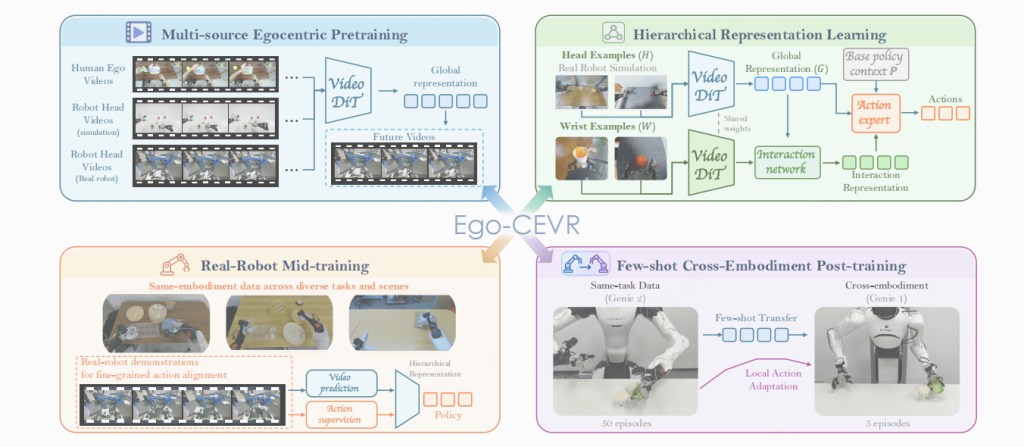
The paper, titled “Ego-CEVR: Learning Cross-Embodiment Visual Representations from Human Egocentric Videos,” argues that while embodied data now comes from human egocentric videos, robot head cameras, wrist cameras and teleoperation demonstrations, mainstream methods tend to mix these sources together without matching each data type to the supervision it can best provide.
Ego-CEVR separates the learning process into three modules. A global module learns task context by predicting future video from egocentric and robot head-camera footage. An interaction module uses wrist-camera images to learn fine-grained execution details, querying the global representation to interpret local actions in task context. An action expert then combines both representations through separate attention channels and generates action sequences via flow matching.
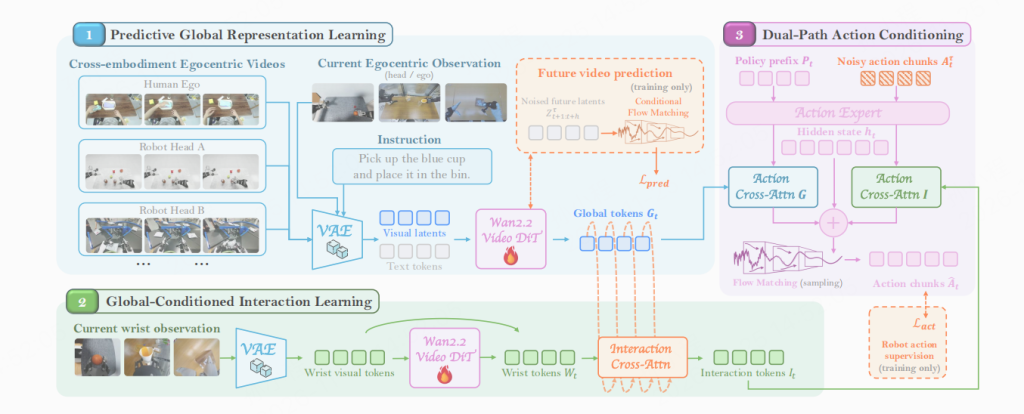
Training follows three stages: pretraining on multi-source egocentric video, mid-training on real robot demonstrations across scenes, and post-training on target-robot and target-scene demonstrations to support few-shot cross-embodiment adaptation.
In simulation, Ego-CEVR reported a 90.2% success rate under seven perturbation categories in LIBERO-Plus, 3.6 percentage points above the next-best method. In the difficult RoboTwin 2.0 setting, trained on clean data and tested in randomized environments, it achieved a 70.7% success rate, 24.7 percentage points higher than pi-0.5, according to the paper.
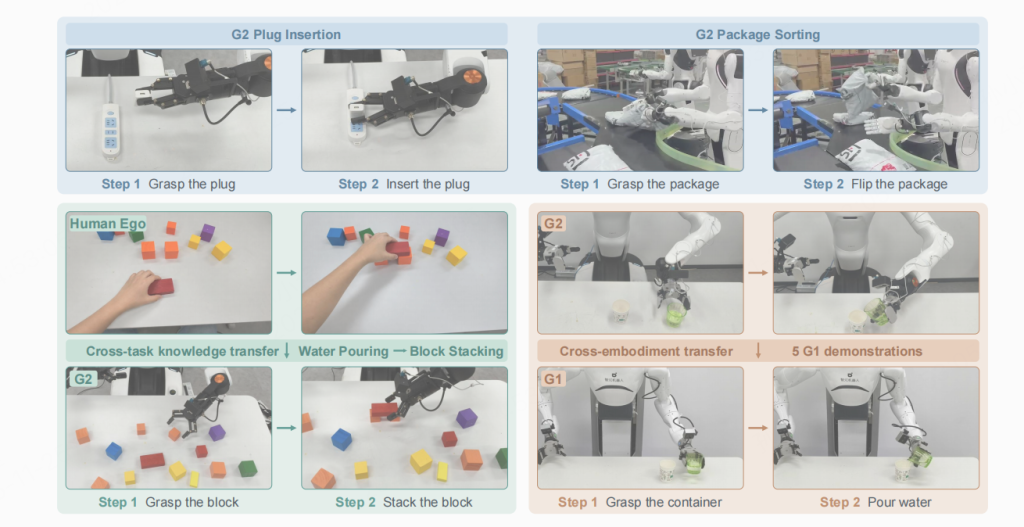
In real-robot tests on AgiBot G1 and G2, adding 10 hours of human egocentric video to the same 50 robot demonstrations raised the success rate for pouring water to 75% from 60%, and for parcel sorting to 80% from 60%. For cross-embodiment transfer from G2 to G1, five demonstrations plus video data raised the success rate to 35% from 5%, versus 50 demonstrations needed under the conventional approach.
Maniformer, which provides real-robot, embodiment-free and simulation data, said the framework is part of its effort to better align data production with model requirements and turn data diversity into an advantage for physical AI.

 AGIBOT
 Figure AI
 UBTECH