Singapore-based embodied AI startup Ropedia said it has released Ropedia W0, a cross-embodiment mobile manipulation world model developed with researchers from Nanyang Technological University, Duke University, the University of California San Diego and Tsinghua University.
The model uses a unified action representation to predict first-person future scene changes after actions by humans, robotic arms and humanoid robots, allowing one model to cover different robot embodiments.
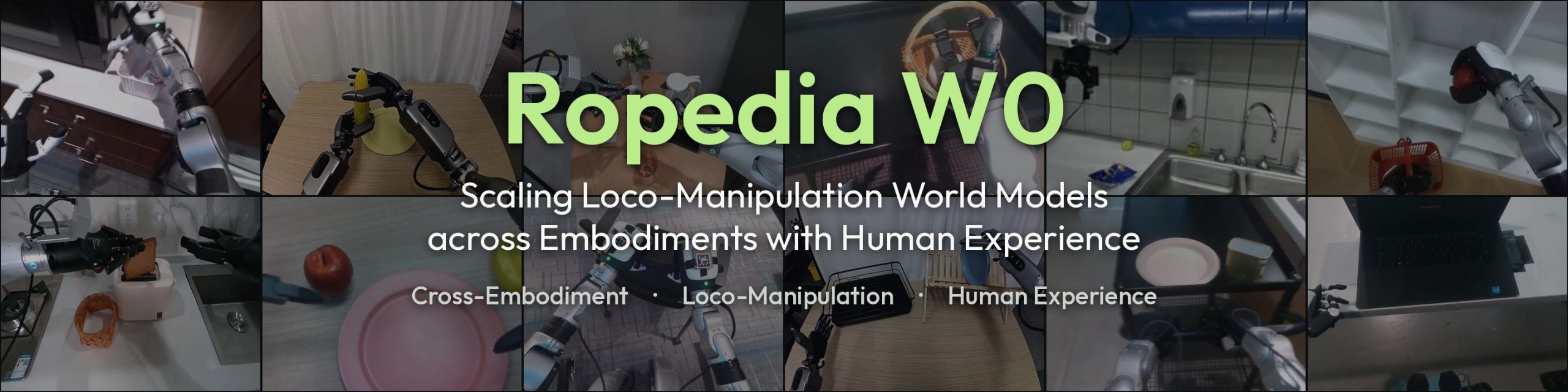
Ropedia said W0 ranked first across five evaluation benchmarks and 11 tests. In the Ψ₀ and ω-HOME benchmarks, W0 outperformed comparison models trained on full data without post-training, the company said. On the DreamDojo official benchmark, W0 exceeded DreamDojo trained on full data using only 1% of post-training data.
The model takes initial frames, text descriptions, camera trajectories and hand actions as inputs and generates future first-person videos. It predicts view and environment changes during movement and hand-object state changes during manipulation. Ropedia demonstrated continuous prediction of mobile manipulation tasks including opening a refrigerator, collecting garbage, sorting fruit and making a bed, with videos exceeding 30 seconds.
W0 is built on a video diffusion model using a diffusion Transformer architecture. Ropedia released two versions: a 5-billion-parameter dense model, Ropedia W0 5B, and a mixture-of-experts model with 14 billion activated parameters, Ropedia W0 A14B. The A14B model was used for cross-embodiment prediction evaluations, while the 5B model was used for real-time interaction and robot action learning experiments.
The training set, Xp-Data, contains about 13,000 hours of multimodal data, including about 10,000 hours of first-person human data and about 3,000 hours of real robot data. Ropedia proposed a cross-embodiment unified kinematic representation that converts movement and manipulation into two generic inputs: camera motion, represented by camera pose and Plücker rays, and projected skeletons, which map key points of human hands, robot grippers and dexterous hands onto the image plane. Training was staged, with large-scale human first-person video pretraining followed by mixed human and robot data training.
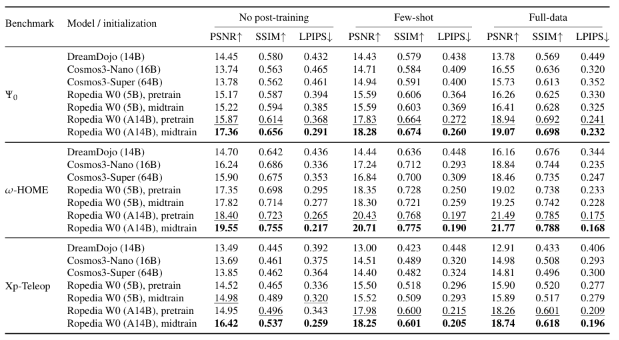
In Ψ₀ evaluation, Ropedia W0 A14B without post-training achieved 17.36 dB in PSNR, compared with 15.73 dB for Cosmos3-Super trained on full data. In ω-HOME, W0 A14B reached 19.55 dB without post-training versus 18.46 dB for Cosmos3-Super with full-data post-training. In Xp-Teleop, W0 A14B reached 16.42 dB without post-training, exceeding comparison models with full-data post-training, and 18.74 dB after full-data post-training.
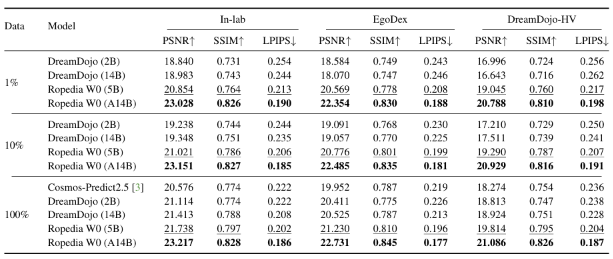
On DreamDojo, W0 A14B with 1% post-training data surpassed DreamDojo 14B trained on 100% data across In-lab, EgoDex and DreamDojo-HV test sets. Scaling from 5B to A14B raised PSNR from 19.83 dB to 21.98 dB.
Ropedia also tested W0 as a simulated environment for policy evaluation and action planning. Predicted task progress correlated with actual execution at 0.984 in simulation and 0.996 on real robots, the company said. In RoboTwin 2.0 simulation, world-model-based planning reached 92% task progress versus 85% for the best policy. On a real Unitree G1 robot, it reached 55% versus 45%. Using W0 5B to initialize robot world-action model FastWAM raised success on LIBERO-Plus from 50.06% to 56.82%, and task progress on real Unitree G1 mobile manipulation from 33.3% to 56.7%.
Ropedia said the results show transfer of predictive capability across embodiments using unified action representations and large-scale human behavior data, and applications in policy evaluation, action planning and model training. It said further validation is needed for more complex and open real-world environments.

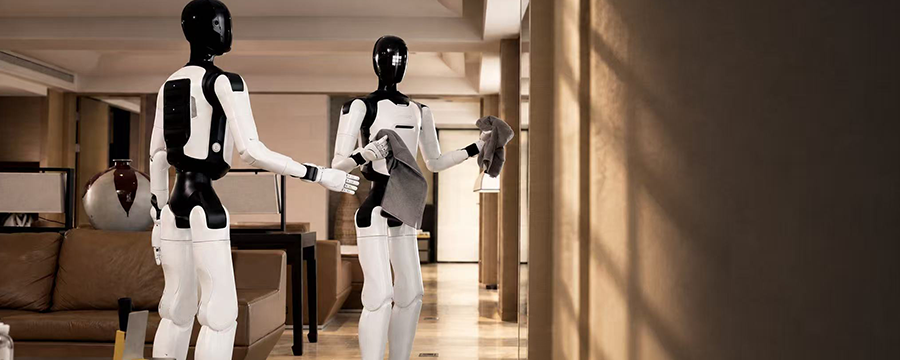 AGIBOT
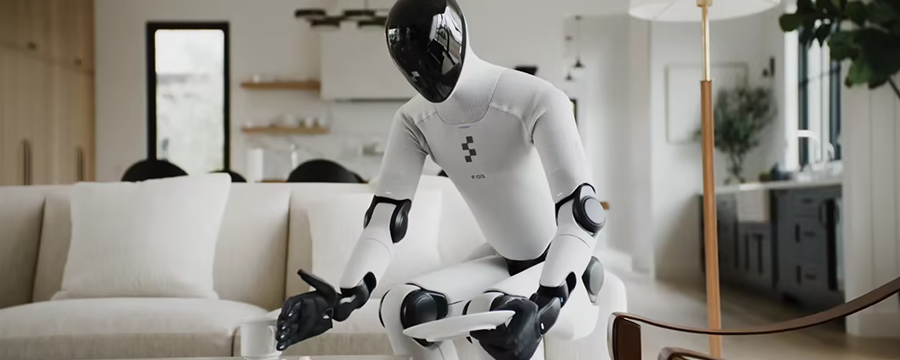 Figure AI
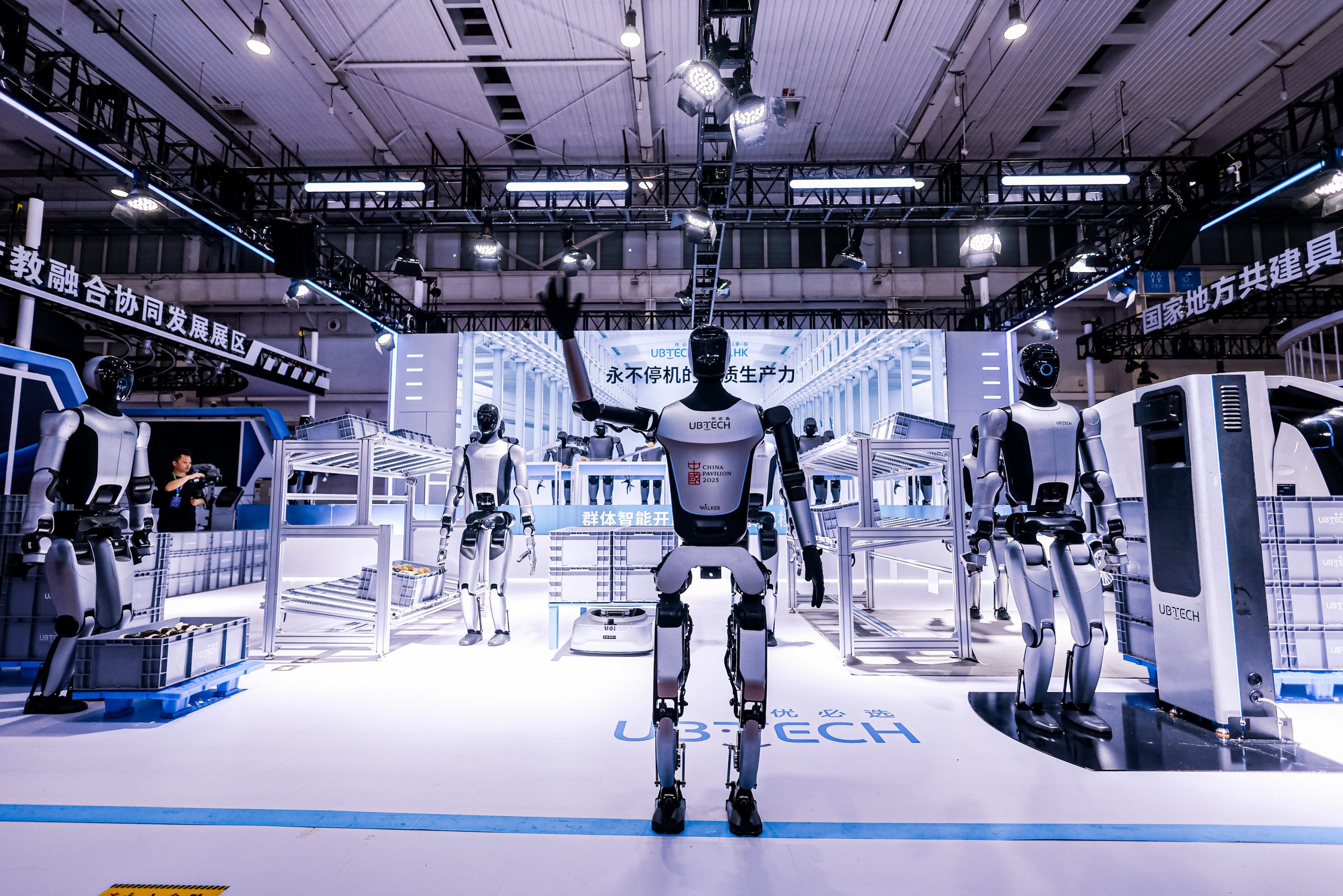
 UBTECH