ACE Robotics has released a visual-spatial grounding-enhanced embodied foundation model, ACE-Brain-0.6, and said the 9-billion-parameter system outperformed OpenAI’s GPT-6 Astra on six of eight grounding benchmarks.
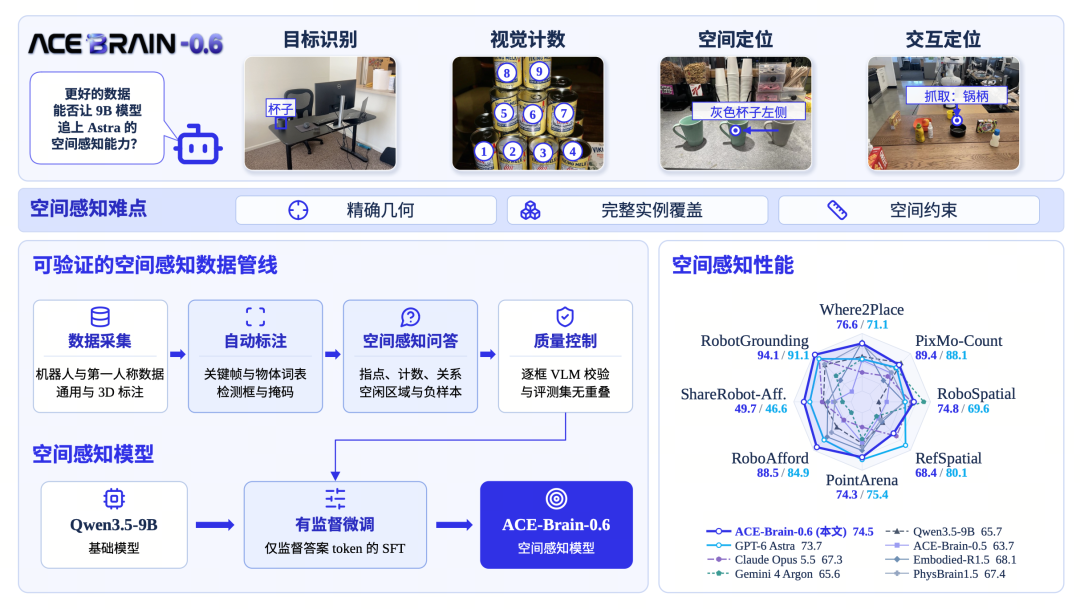
The company said the model is designed to improve target identification, spatial localization and interaction anchoring—capabilities it described as critical for translating high-level task reasoning into reliable physical action. It builds on the earlier ACE-Brain-0.5 and focuses on visual grounding: identifying target objects, interaction areas and spatial references, and linking them to position, displacement and motion parameters.
In seven public benchmarks, ACE-Brain-0.6 averaged 74.53 points versus 73.68 for GPT-6 Astra, according to the company. It said the model beat GPT-6 Astra on six of eight evaluations, including Where2Place (76.55 vs. 71.10), PixMo-Count (89.41 vs. 88.10), RoboSpatial (74.82 vs. 69.55), RoboAfford (88.51 vs. 84.94), ShareRobot (49.70 vs. 46.60) and its own RobotGrounding (94.13 vs. 91.10).
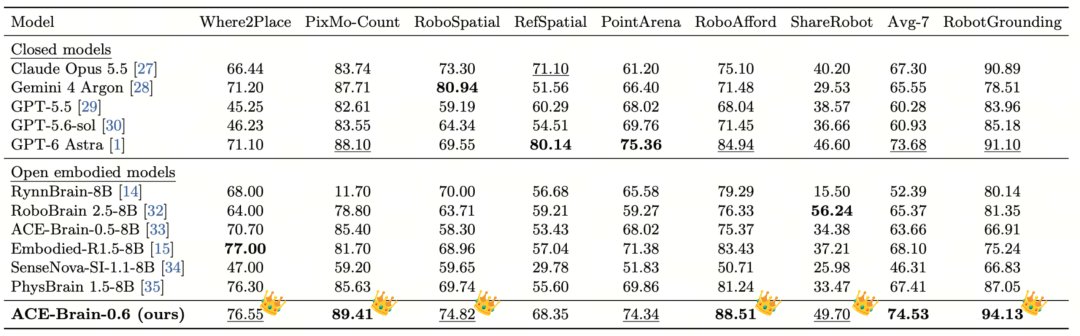
RobotGrounding contains 2,591 questions across 14 task types, including target localization, small-object recognition, multi-instance counting, target-absence judgment and cross-camera view matching, the company said. It said the model also led comparisons with Google Gemini 4 Argon, Anthropic Claude Opus 5.5, Alibaba DAMO Academy and Beijing Academy of Artificial Intelligence models.
ACE Robotics said it trained the model on about 1 million samples covering roughly 940,000 images and 2.7 million question-answer pairs. The data pipeline combines more than 30 open-source robot data families and private ego data, with automated annotation using tools including Grounding DINO and SAM 3. The model is based on Qwen3.5-9B, with a frozen vision encoder and supervised fine-tuning of language-model parameters.
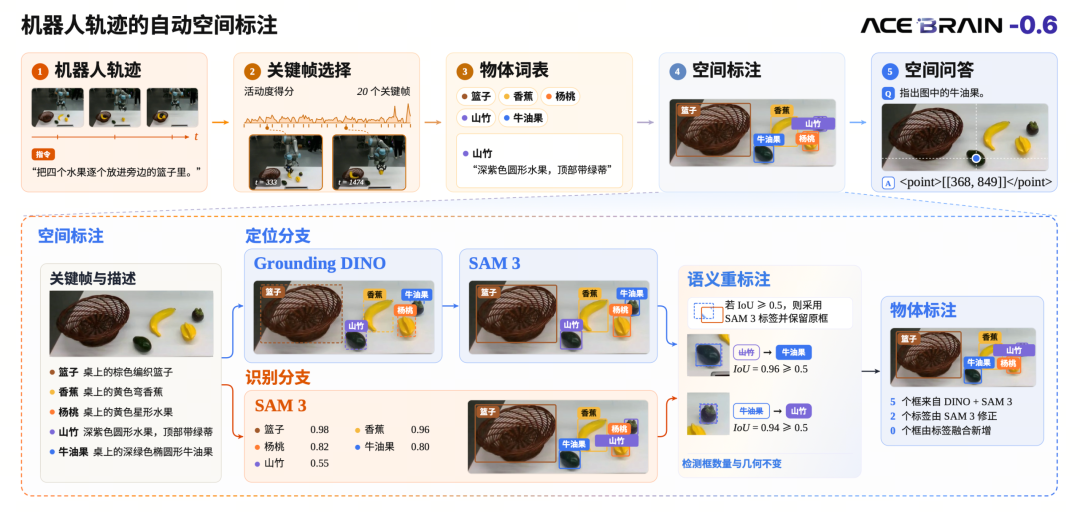
The company also reported a controlled scaling experiment: expanding training data from 260,000 to 1 million samples raised the seven-public-benchmark average from 69.3 to 74.5, a roughly log-linear gain of about 2.4 points per doubling. It said simply adding more samples of existing data types improved performance by less than 1 point, while introducing new scenes, spatial relations and supervision formats drove larger gains.



 AGIBOT
 Figure AI
 UBTECH