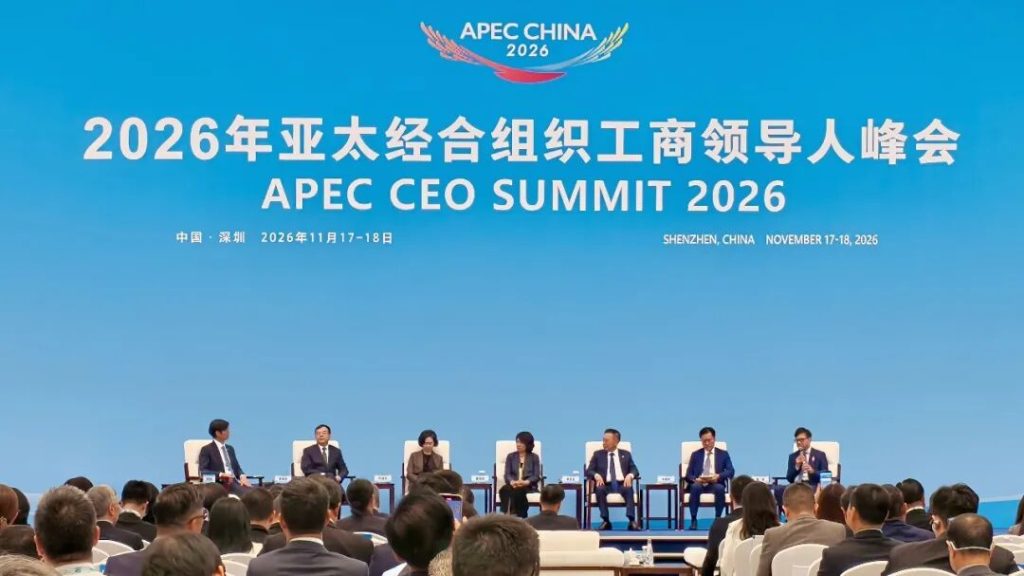
UBTECH Robotics founder, chairman and CEO Zhou Jian attended the APEC CEO Summit and joined a panel on Greater Bay Area and Asia-Pacific development opportunities during 2026 APEC China Year events in Shenzhen.
UBTECH displayed its full humanoid robot lineup at the Qianhai Jilang “Bay Area Reception Hall” and Shenzhen Robot Valley, demonstrating embodied AI applications in industrial, commercial and consumer scenarios.
Zhou took part in the Nov. 17 panel alongside executives from HSBC, China Life, Shun Tak, Gree, AIA and TCL, discussing institutional opening, innovation coordination, industrial upgrading and Asia-Pacific trade cooperation.
He said humanoid robots are a representative direction for “new quality productive forces” and that the next 20 to 30 years could bring major changes to global industrial models if robots can handle flexible work at scale. The scarce part is not a single technology breakthrough but a complete chain from technology to mass production and usable productivity for Asia-Pacific partners, he said.

Zhou said the Greater Bay Area’s mature supply chain allows core components such as actuators, reducers, motors and joint modules to be sourced in Shenzhen, supporting rapid product iteration. UBTECH’s Hong Kong listing also helps link capital and research resources, he added.
He said general-purpose humanoid robots with strong generalization still need time, and physical AI has not yet entered daily life quickly. Scenario data and edge-side understanding of real environments are key, and there is no one-size-fits-all solution across Asia-Pacific economies, he said. UBTECH works with local partners on secondary development and provides integrated software-hardware solutions rather than selling hardware alone.
In Thailand, UBTECH has built a co-creation center with King Mongkut’s University of Technology Thonburi and opened hardware SDK interfaces to support local applications in automotive and new energy. In South Korea, it is working with partners to run proof-of-concept tests of industrial humanoid robots at auto parts makers. It is also collaborating with Hitachi and Honda Trading on joint validation in smart manufacturing. Zhou described the model as “capability symbiosis, not a one-way transplant.”
The company is also targeting aging populations and education. UBTECH has partnered with Japanese and Singaporean partners on secondary development and testing of ultra-bionic humanoid robots for elderly care, including voice interaction and emotional companionship. Its AI robot education solutions have been deployed in schools in South Korea, Singapore and Vietnam.
Zhou said cross-cultural scenario understanding and technology ethics are major barriers to scaling humanoid robots. UBTECH released what it described as the world’s first white paper on ethical governance of humanoid robots in September and called for greater exchange and consensus on standards.

At the Qianhai venue, UBTECH showed the U1 Pro ultra-bionic humanoid robot, which uses its Resonance-LM emotional resonance model to recognize more than 20 fine-grained human emotions and performed “Auld Lang Syne.” The full-size commercial service humanoid Walker C1 handled reception and a waltz performance, while consumer robots Wukong and Meng UU drew visitor attention.
At Shenzhen Robot Valley, UBTECH demonstrated the Walker S2 and Cruzr Y1 industrial humanoid robots, including autonomous battery swapping and depalletizing and palletizing. UBTECH describes Walker S2 as the world’s first humanoid robot with autonomous battery swap, using its BrainNet 2.0 group brain network and Co-Agent technology for 24/7 operations. It said the robot has been deployed in aviation, automotive, consumer electronics, smart logistics and semiconductors. Cruzr Y1 targets palletizing and depalletizing, addressing pain points in traditional automation such as poor adaptability and long changeover times.

 AGIBOT
 Figure AI
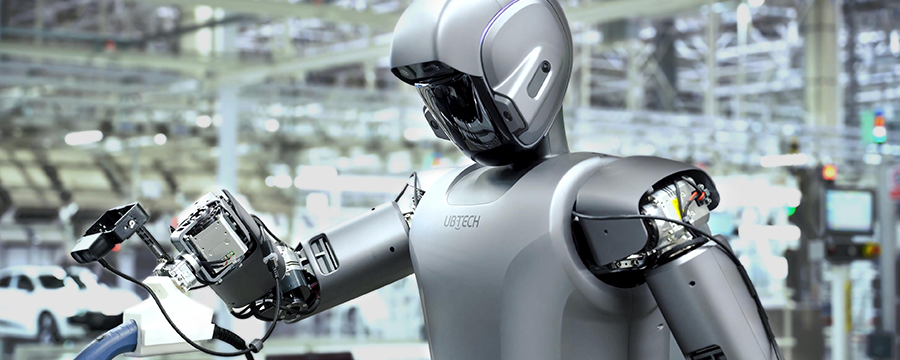 UBTECH