Lumos Robotics on Thursday launched its new heavy-duty wheeled-arm embodied intelligence robot Lumos MOS2, targeting real-world industrial scenarios with a 50 kg dual-arm payload capacity and upgrades in mobility, perception, and control architecture.
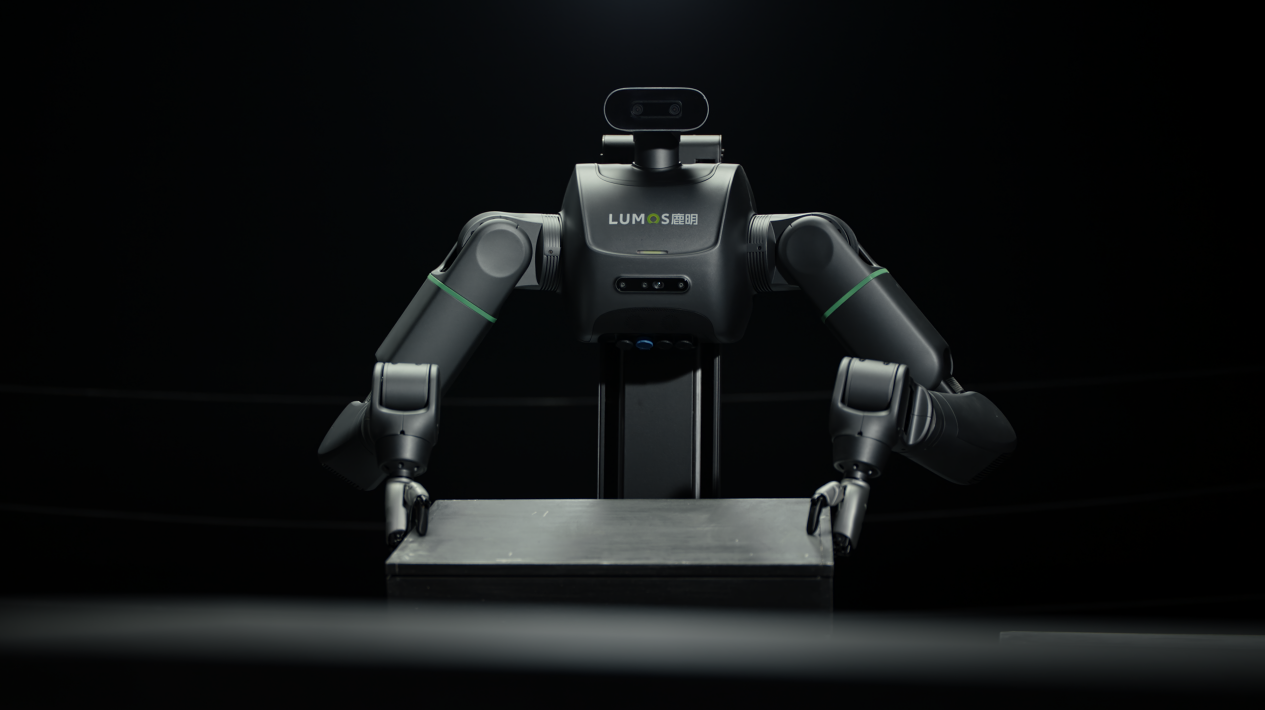
The 1.65-metre-tall robot, which occupies a floor space of roughly 0.5 square metres and requires a passage width of about 0.8 metres, features 22 degrees of freedom, including a two-degree-of-freedom head and an omnidirectional chassis. It is equipped with dual multi-line lidar on the chassis, dual wrist cameras, dual six-axis force sensors, and a binocular camera on the head, with optional top rear lidar and chest depth vision modules.
“We are seeing embodied intelligence accelerate into industrial deployment,” said Yu Chao, founder and CEO of Lumos Robotics. “How to make robots complete more real-world tasks efficiently depends on data acquisition efficiency, hardware cost, and industrial delivery efficiency.”
Positioned as a “heavy-load AI Worker” for factory environments, the MOS2 is designed to operate 24/7 while possessing environmental perception, task understanding, and autonomous manipulation capabilities. The company said it represents a productised practice of its “industrial embodied” philosophy.
Bridging the gap in heavy-load, flexible tasks
According to Lumos Robotics, while conventional automation has addressed standardised, high-volume production over the past decades, many industrial tasks remain poorly served due to frequent line changeovers, complex assembly requirements, low-volume production that makes dedicated equipment uneconomical, and dynamic on-site conditions.
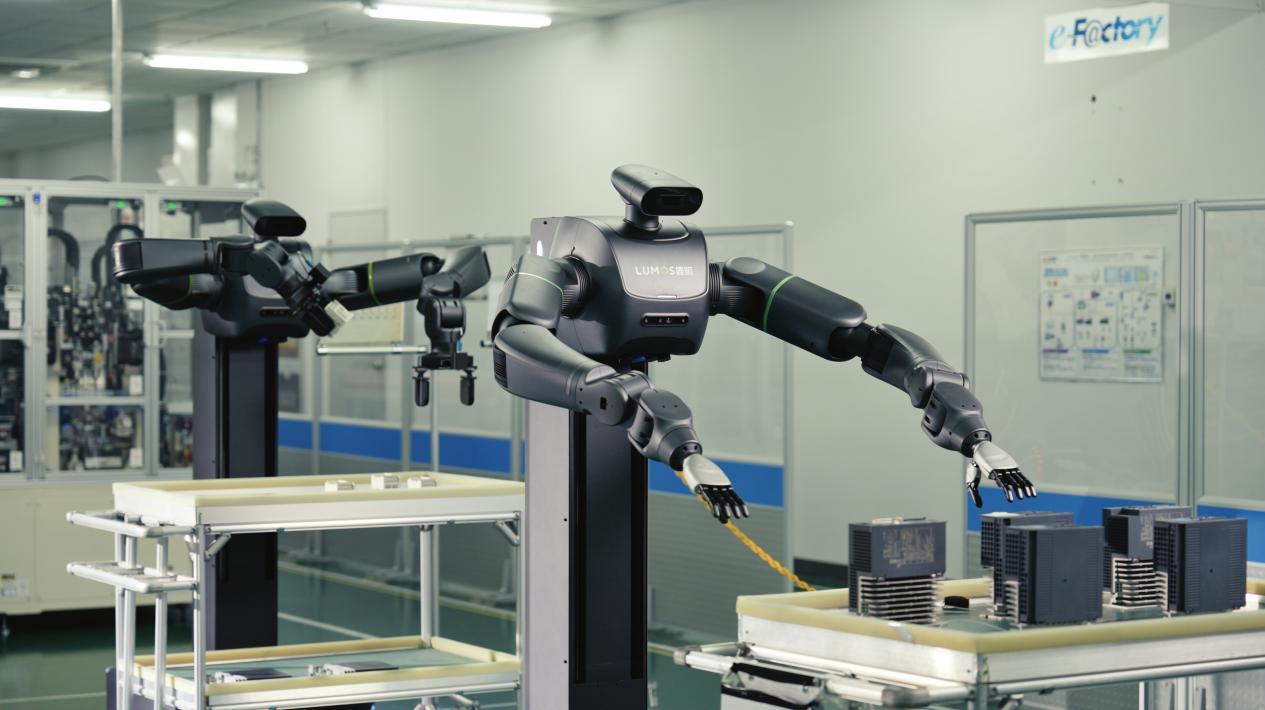
The wheeled-arm form factor allows the MOS2 to move freely between workstations, while the dual-arm design enables complex interactions with the environment. The robot’s 50 kg payload capacity – achieved through a standard flange and integrated interface design that supports rapid end-effector swapping – provides greater capability for heavy-load material handling, flexible machine tending, and assisted equipment operations requiring coordinated bimanual actions.
Reliability features include a 5-million-cycle durability test for cable harnesses and a dual-battery hot-swap solution to support continuous operation.
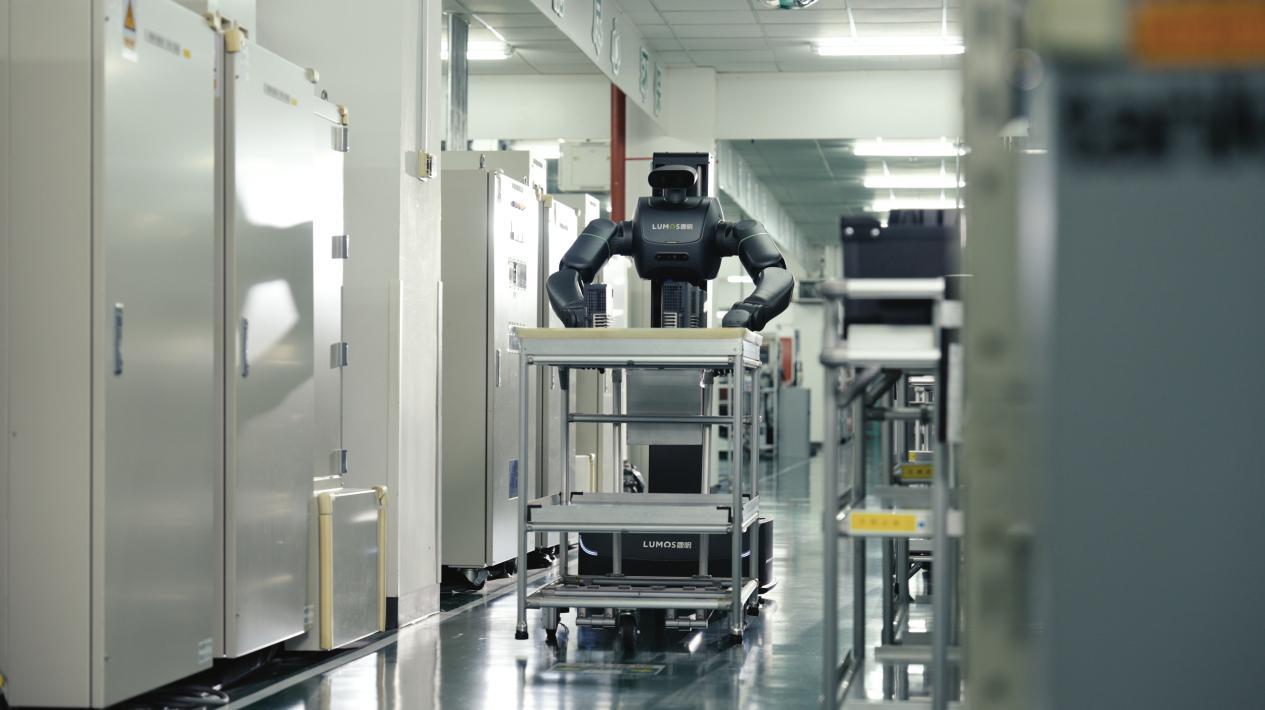
Learning and evolving on the job
Beyond hardware, Lumos Robotics emphasised the robot’s ability to continuously improve through its NexCore learning system, which creates a closed loop: users define tasks, incorporate multi-source data (real, simulated, video), automate training and parameter optimisation, validate skills through multi-dimensional evaluation, and deploy validated skills to robots. Operational data from real-world execution feeds back into the system for ongoing refinement.
“The value of robots for industrial customers must be measured by real production outcomes – continuous uptime, task success rates, deployment efficiency, and ultimately the industrial value created,” Yu said.
Lumos Robotics said the MOS2, together with NexCore, is intended to become an industrial intelligence that can work persistently, learn continuously, and generate tangible value on factory floors.
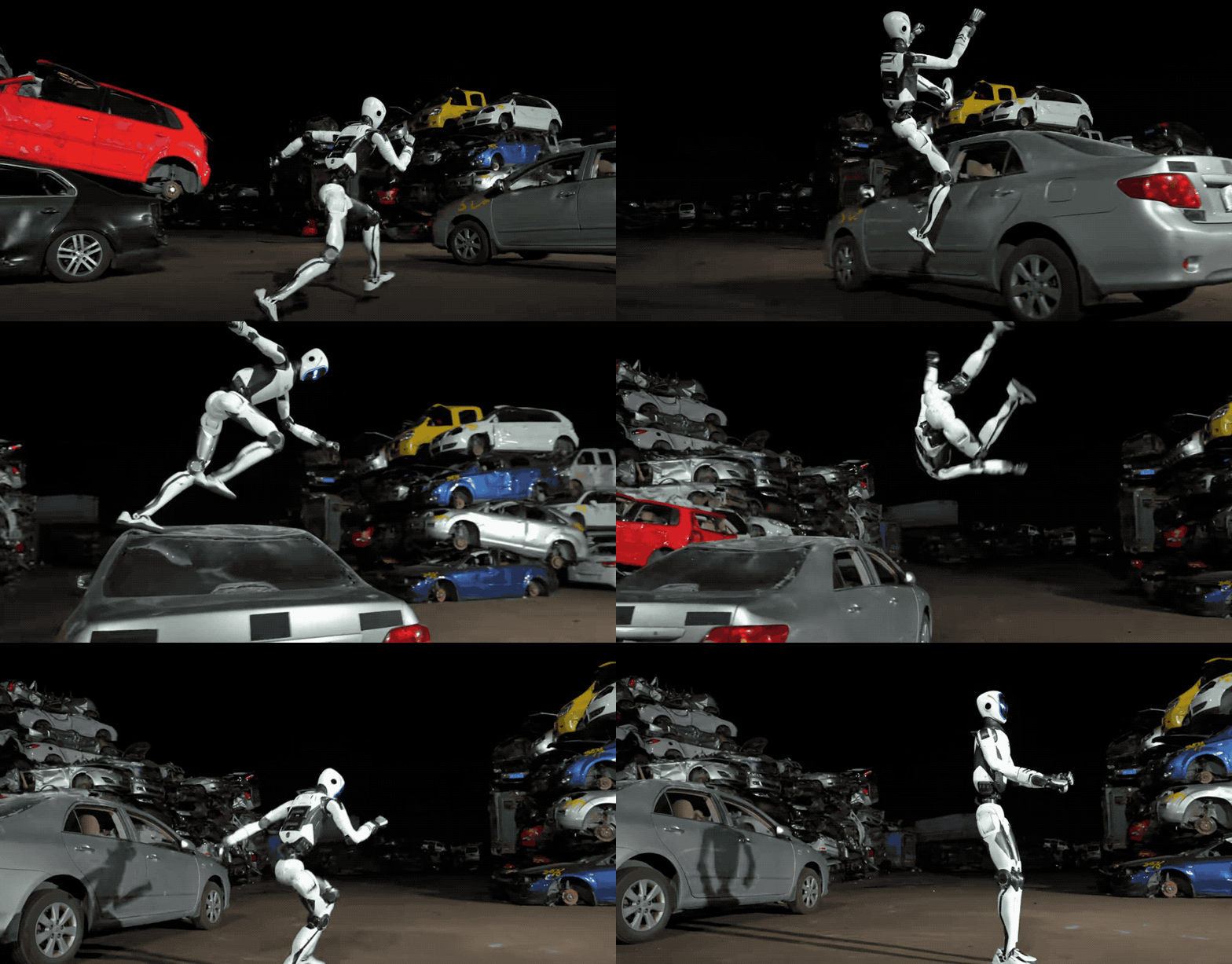


 AGIBOT
 Figure AI
 UBTECH