Chinese robotics company SEAHI ROBOTICS has completed government registration for its ocean general-purpose foundation model “CEORION”, which it says is the world’s first such model, marking the latest push by Chinese firms to stake out a lead in frontier artificial intelligence.
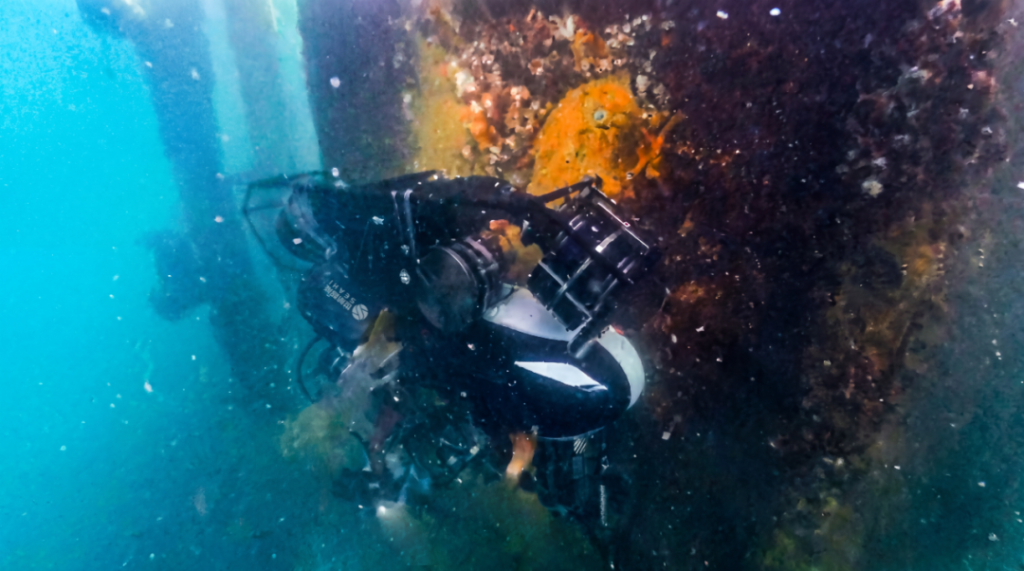
The model, backed by the company’s proprietary LWAM (Language-World-Action) unified architecture, dynamically fuses multi-dimensional sensing data – vision, acoustics, pressure, fluid and posture – into an end-to-end unified neural network, enabling integrated semantic understanding, environment modeling and action generation. SEAHI says this supports a full closed-loop of autonomous operations, from underwater perception and task assessment to path planning, autonomous execution and emergency response.
The registration, filed with China’s Cyberspace Administration, means a Chinese company has for the first time traversed the complete chain – self-developed underlying technology, model training and iteration, and compliant industrialized services – in ocean general AI, a field with no ready-made international template.
Unlike land-based AI, ocean foundation models must contend with extreme conditions: waves, currents, high salinity, high pressure and corrosion, with limited light and constrained communications that blunt vision-dependent models. High data-collection costs and long cycles, plus wide differences across sea areas, depths, water quality, light conditions and robot platforms, further impede data accumulation and generalization.
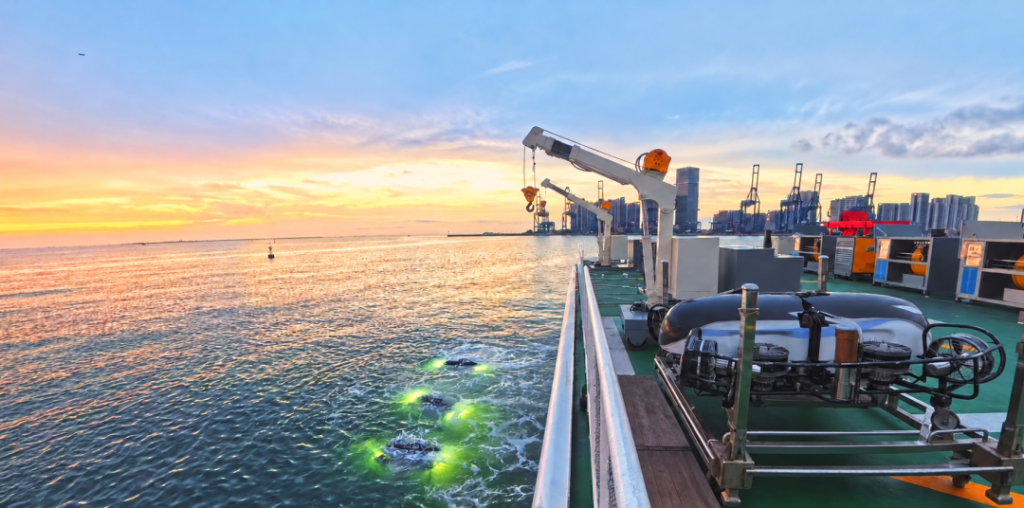
Drawing on 19 years of technological buildup and large volumes of real-world data, SEAHI said CEORION delivers several “world firsts”:
– Elastic modal perception: the “brain” automatically adjusts sensing channels, merging sonar, force, inertial navigation and vision to maintain stable perception and operations in zero-light, high-turbidity waters.
– A native ocean world model: for the first time, complex marine hydrodynamic and kinematic constraints are encoded into the lower layers of a neural network, allowing accurate prediction of current impact and force feedback for proactive, real-time adaptive control.
– Cross-scene, cross-task generalization: the company built multi-domain ocean expert models coordinated through the LWAM architecture, moving capability from specialized tasks toward broad, self-directed execution.
– Multi-scenario adaptation: without switching models, the foundation supports 12 categories of underwater work – inspection, detection, cleaning, grasping, cutting, welding, exploration, search and rescue, emergency response, mining, maintenance and sealing.
SEAHI said the technology has been deployed in ship cleaning, port dredging and green operations, aquaculture, marine engineering and infrastructure, and deep-sea resource exploration and development, with commercialization and scaled application underway.
It framed the milestone as part of China’s drive to build a “maritime power” through ocean technological innovation and the deeper integration of AI and robotics.


 AGIBOT
 Figure AI
 UBTECH