Chinese robotics company SEAHI ROBOTICS has completed government registration for its ocean general-purpose foundation model “CEORION”, which it says is the world’s first such model, marking the latest push by Chinese firms to stake out a lead in frontier artificial intelligence. The model, backed by the company’s proprietary LWAM (Language-World-Action) unified architecture, dynamically fuses multi-dimensional sensing data – vision, acoustics, pressure, fluid and posture – into an end-to-end unified neural network, enabling integrated semantic understanding, environment modeling and action generation. SEAHI says this supports a full closed-loop of autonomous operations, from underwater perception and task assessment to path planning, autonomous execution and emergency response. The registration, filed with China’s Cyberspace Administration, means a Chinese company has for the first time...
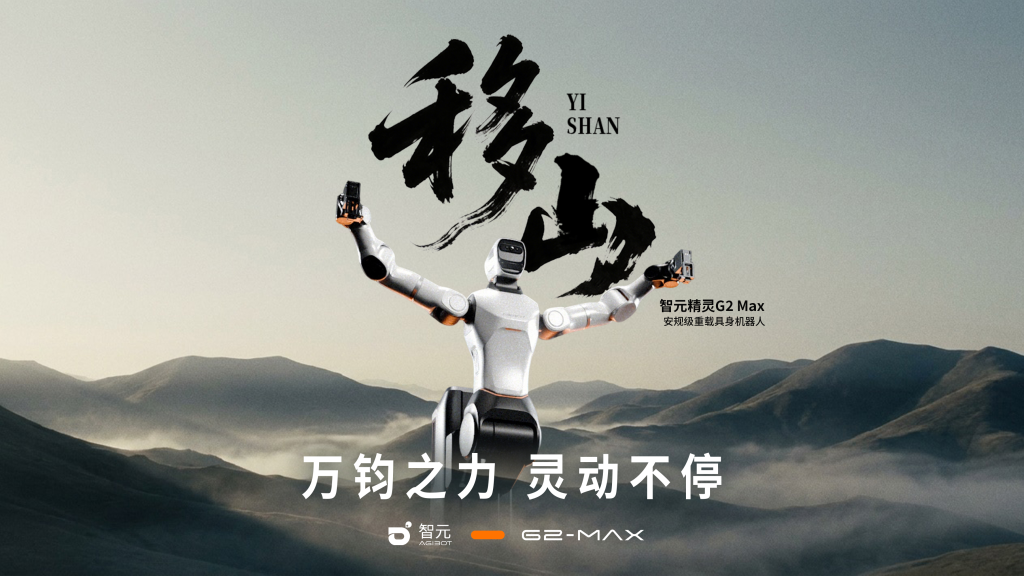
AGIBOT has launched the Genie G2 Max, a safety-standard-compliant heavy-duty embodied robot designed to address a long-standing trade-off in industrial handling: heavy-duty equipment struggles with fine tasks, while precision equipment cannot carry large loads. The robot is the third installment in the company’s AI WAVE series, AGIBOT said. The Genie G2 Max has a single-arm payload of 20 kg, a dual-arm rated payload of 40 kg and a peak dual-arm payload of 50 kg. Its arm repeat positioning accuracy is ≤±0.5 mm. AGIBOT said the robot is the industry’s first heavy-duty embodied robot capable of long-range, multi-task operations. “Embodied intelligence is not a demo in the lab; its value must be tested on real production lines,” Yao Maoqing, co-founder, co-president...
The Beijing Humanoid Robot Innovation Center said its open-source RoboMIND dataset has surpassed 50 million cumulative global downloads since it was open-sourced in December 2025, making it the most-downloaded and fastest-growing open-source dataset in embodied AI.The latest 10 million downloads took 18 days, compared with 223 days for the first 10 million and 39 days for the second. RoboMIND is the first open-source dataset to simultaneously support dual-arm coordination, mobile manipulation, dexterous hands and high-fidelity tactile sensing, according to the center, allowing developers to train robots across a full action chain from grasping and carrying to fine manipulation. The center also described RoboMIND as the world’s largest unified, multi-embodiment public robot manipulation dataset, with more than 400,000 dual-arm manipulation trajectories...
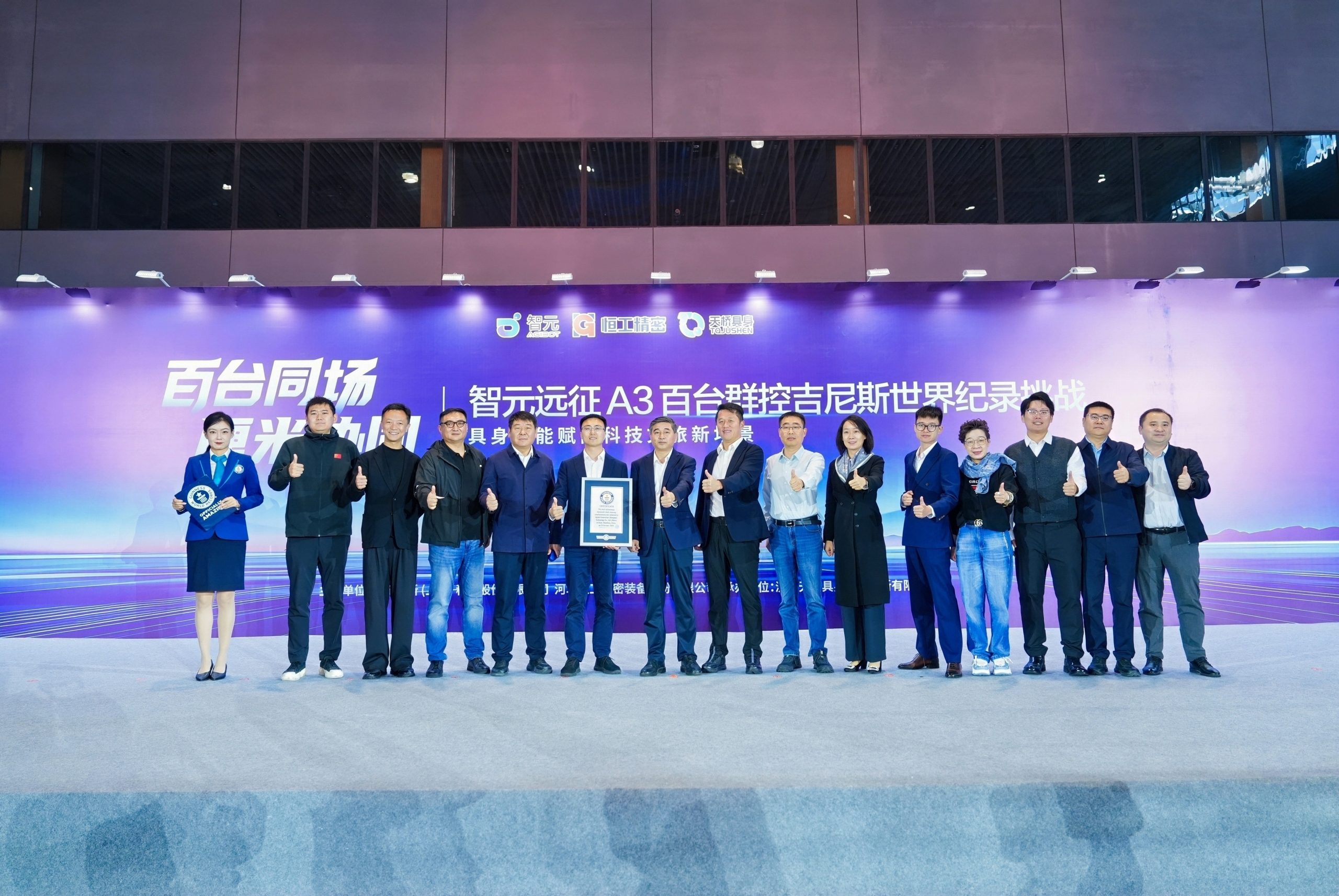
China’s AGIBOT said its Expedition A3 humanoid robots have set a Guinness World Record for the most humanoid robots dancing simultaneously, with 110 full-size units performing coordinated routines at the Yellow River International Convention and Exhibition Center in Jinan, Shandong province. Guinness World Records adjudicators attended the event and issued an official certificate. The robots performed coordinated dance moves, wave-like formations and countdown numerals. Wang Chuang, AGIBOT partner and senior vice president, said all 110 units were mass-production models rather than specially tuned demonstration machines. “Each robot’s joint zero position, torque and motion library are unified at the production-line level. That consistency allows 110 robots to perform as one, and the demonstration site is the delivery site,” Wang said. The...
A research team at the University of Hong Kong’s MMLab has proposed a simple and efficient self-evolving embodied AI baseline, PhysicalRSI 1.0, which ranked first on the RoboDojo benchmark with a 31.38% average task success rate at roughly 1% of the token cost of GPT-6 Astra, the team said. PhysicalRSI 1.0, short for Physical Recursive Self-Improvement, achieved a 36.27 score and 31.38% success rate under a unified five-category evaluation, compared with GPT-6 Astra’s 28.86 score and 22.21% success rate. The result represents a 39.6% relative improvement in success rate over Astra at a fraction of the cost. Astra reportedly consumes about 200,000 yuan in tokens for a full RoboDojo test run. The system uses a “System 1–2 Co-Evolution” framework in...
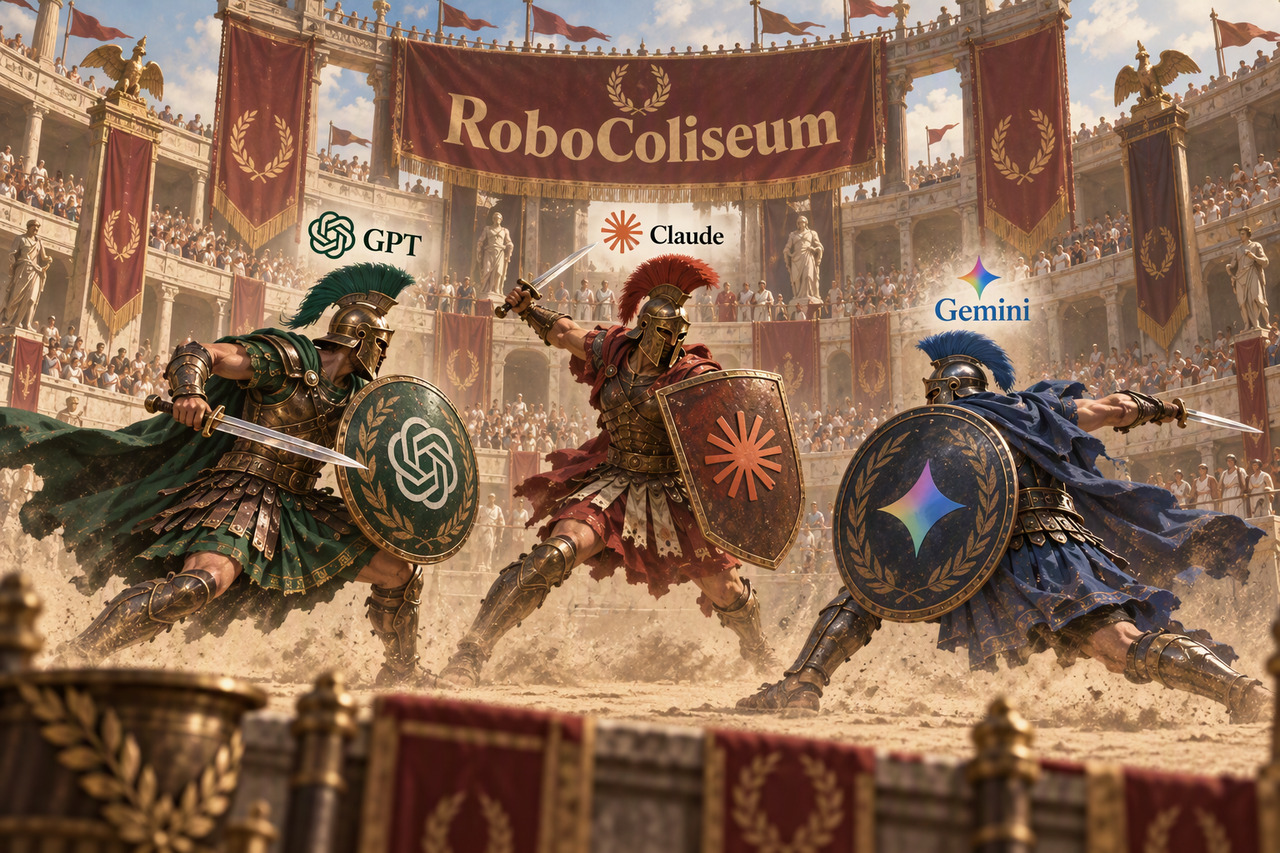
RoboColiseum, an embodied AI evaluation platform co-founded by Maniformer, Hugging Face, NVIDIA and Tsinghua University, said Claude Opus 5.5 ranked first among four flagship general-purpose models in its latest round of testing, with GPT-6 Astra second. GPT-6 Astra led in instruction following and overall disturbance adaptation, scoring 99.35 on instruction following, according to the results released on Oct. 20. Opus performed better in spatial reasoning and general manipulation, and took the top spot among flagship models with the lowest total token consumption across all evaluation rounds. GPT-6.1 Sol lagged the other three models in image-quality perturbation tests, the platform said. Despite Opus’s lead among general models, the top two positions in the overall ranking were still held by embodied policy...
Chinese humanoid robot startup LimX Dynamics is exploring U.S. business collaborations and holding talks with international investors as it pushes to expand globally. The Shenzhen-based company recently showcased its humanoid robot at CES in Las Vegas. LimX plans to enter overseas markets through local partners and investors, with the Middle East first on its roadmap. The startup aims to start shipping humanoids to the region this year and has secured its first foreign backer there, Zhang said. He declined to disclose details of the investors or the size of an ongoing funding round, which the company said would multiply its valuation from its Series A round. LimX has raised $69.31 million as of July 2025, according to PitchBook, with backers...
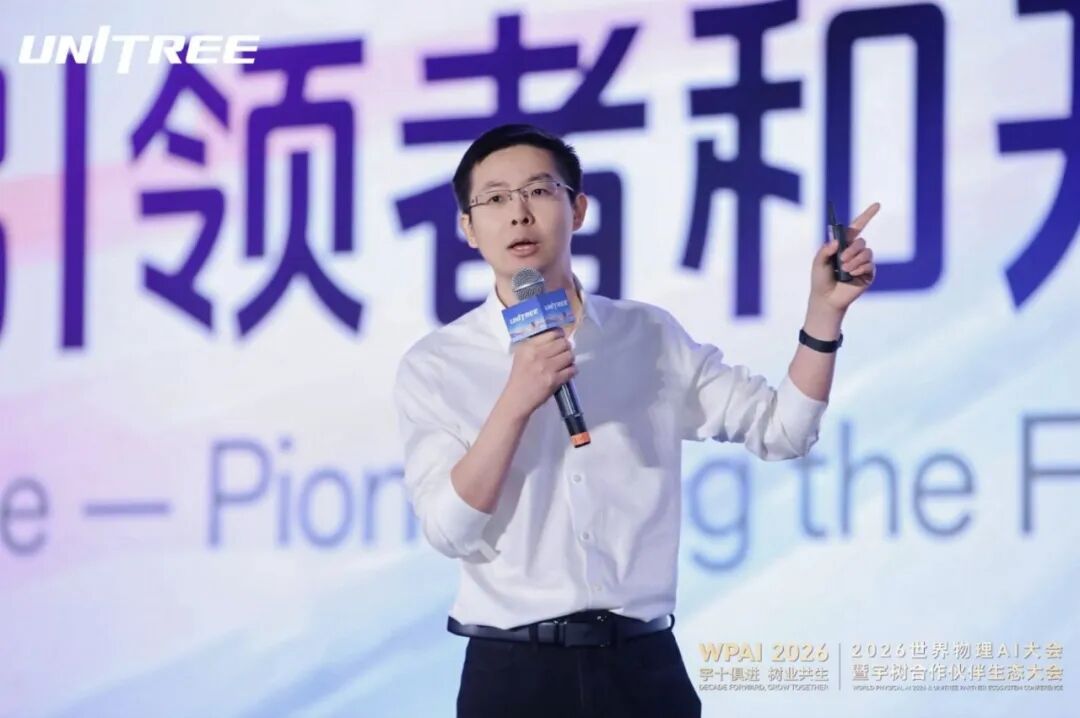
Unitree Robotics founder Wang Xingxing said physical AI could see major breakthroughs within one to three years, as the Chinese robot maker held its first partner ecosystem conference to mark its 10th anniversary. Speaking at the 2026 World Physical AI Conference in Hangzhou under the theme “Believe, Believe in AI as Much as Possible,” Wang said almost everyone worldwide, including himself, still underestimates AI. He noted he had recommended AI-related stocks to colleagues four or five years ago, saying some employees’ personal wealth could have grown tenfold or more had they believed in AI more strongly. Wang said the lag between technological breakthrough and mass adoption typically runs five to 10 years, citing the near-decade from the internet bubble around...
AGIBOT open-sourced the fourth installment of its AGIBOT WORLD 2026 dataset series, “Physical Reasoning,” describing it as the first real-world Physical Agent dataset designed to train robots not only to execute actions but also to decide what to do under changing conditions. The company said the dataset marks a shift in task design from manipulation difficulty to decision difficulty, linking goal understanding, process memory and action execution in real-world tasks. It covers nine categories of logical reasoning scenarios and, for the same task, deliberately captures multiple real-world states and execution branches. It provides both high-level question-answer annotations and low-level action trajectories, supporting coordinated training from task decision-making to real-machine execution. The release is the first installment of AGIBOT’s AI WAVE...
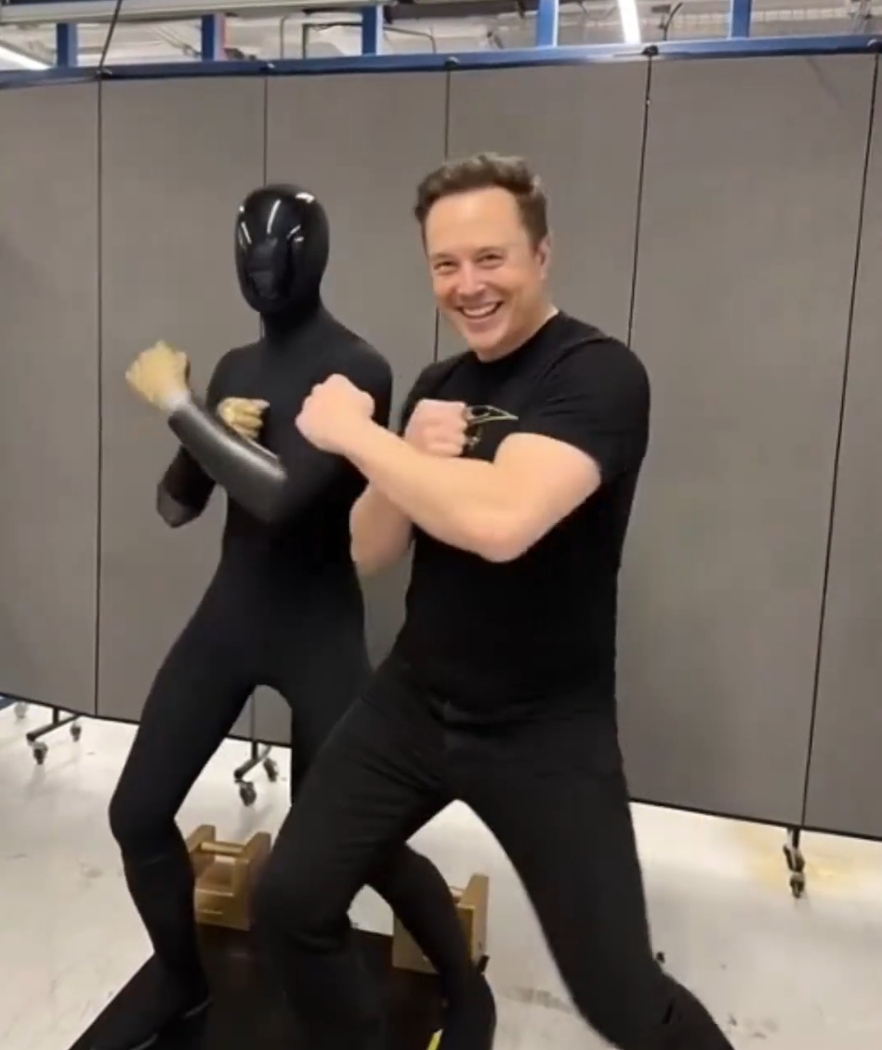
Tesla CEO Elon Musk said on the company’s third-quarter 2026 conference call that Optimus still needs further work on artificial intelligence, electromechanical systems, safety and durability, and that external deliveries are only “possible” by the end of next year, not a firm commitment. The update offered no breakthrough for investors and robotics enthusiasts who had hoped for a concrete commercial timeline. The Fremont factory has begun “early production” on a high-volume Optimus line, Musk said, and most of the equipment for a 1-million-unit annual capacity line is already installed. But reaching an annualized rate of 20,000 units a week, roughly 1 million a year, will take “probably at least a year, maybe a little longer,” he said, citing continuing design...