Astribot, an embodied AI company, said three papers co-authored with universities including the University of Hong Kong and the University of Tokyo have been accepted at the 10th Conference on Robot Learning (CoRL 2026), being held in Austin, Texas, from Nov. 9 to 12.
The papers address autonomous improvement during real-world deployment, predictive action generation based on latent world models, and perception, memory and dual-arm coordination in long-running online operation — three capabilities the company says general-purpose robots need to work reliably over time.
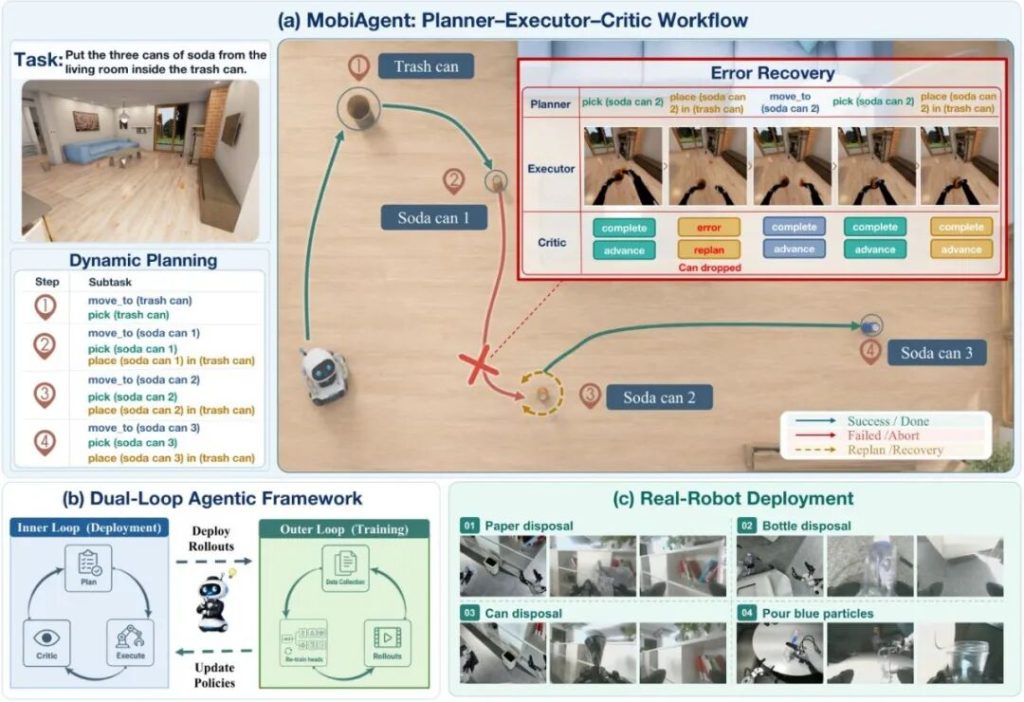
In MobiAgent: Dual-Loop Recursive Policy Self-Improvement for Long-Horizon Mobile Manipulation, Astribot proposes a dual-loop agent framework for long-horizon mobile manipulation. During deployment, a vision-language model handles rolling task planning, skill-specific action experts execute operations, and a reflection module checks results and triggers replanning when errors occur. In an example cited by the company, if a robot misses a can while throwing three cans into a bin, MobiAgent can identify the failure and return to pick it up, rather than continuing with the original plan.
In the offline stage, the system automatically segments, validates and categorizes deployment data by skill, then uses it to improve skill policies without manual labeling. On BEHAVIOR-1K long-horizon tasks, MobiAgent achieved an average success rate of 65.0%, 22.5 percentage points higher than the winning solution in the 2025 BEHAVIOR Challenge, according to the company. On Astribot’s S1 robot, two rounds of autonomous data collection and iteration raised the average success rate on four long-horizon tasks to 57.5% from 32.5%.
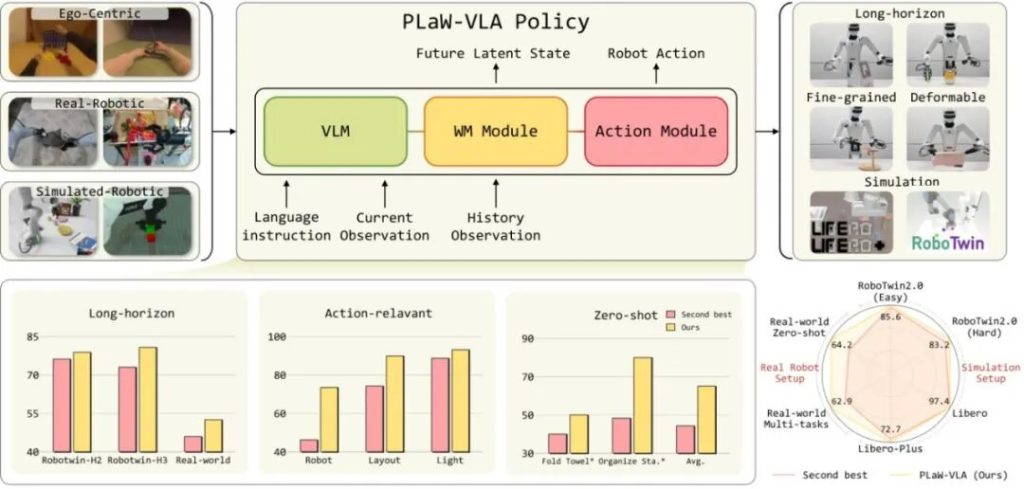
In PLaW-VLA: Predictive Latent World Modeling for Vision-Language-Action Policies, Astribot’s researchers model task-relevant future states in a latent representation space rather than reconstructing visual details such as texture and background, and use structured causal attention to guide action generation. The model follows a three-stage training paradigm: action-free video pretraining, joint learning on robot trajectories, and task and embodiment adaptation.
PLaW-VLA’s success rate was 11.8 percentage points higher than that of π0.5 in RoboTwin 2.0’s most complex long-horizon task group, the company said. It scored 72.7% on the zero-shot generalization benchmark LIBERO-Plus and had inference latency about one-nineteenth that of generative world-action models at comparable performance.
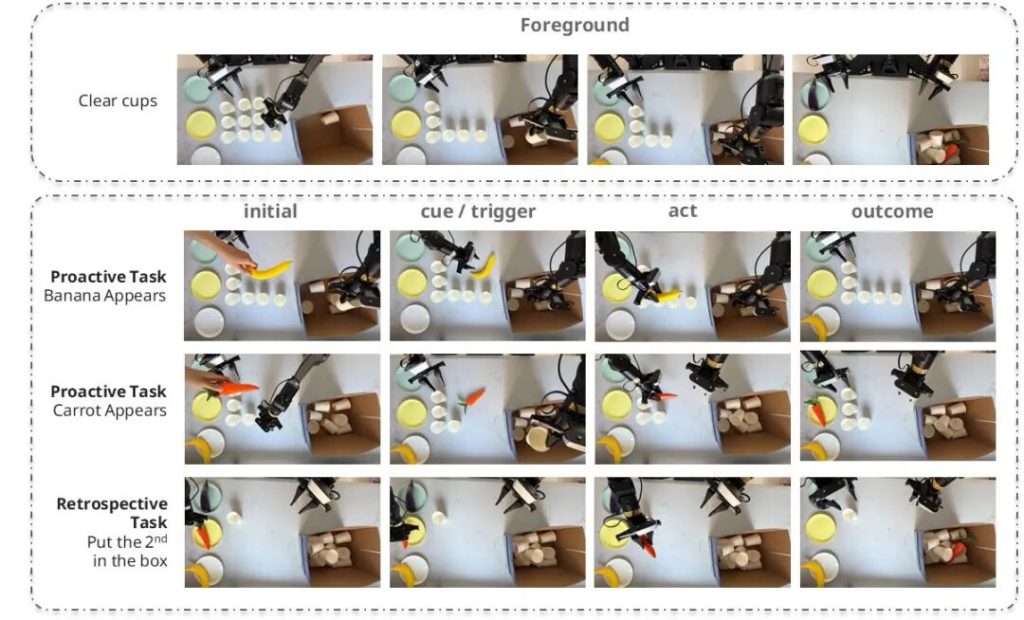
In Watch, Recall, Act: Always-On Robots in Concurrent Embodied Streams, Astribot proposes ARMS, a streaming policy that adds visual triggering, proprioceptive state description and self-action memory modules to a single pretrained model. The modules update asynchronously, allowing a robot to use an idle arm to respond to new requests while tracking which hand handled which object and when.
ARMS achieved a 45% success rate in a comprehensive task evaluation, compared with 28% for the strongest baseline. In real-robot tests, its historical action recall success rate reached 60%, and task retention was 67% during uninterrupted operation of more than 10 minutes, the company said.
Astribot said the acceptances reflect its continued research in embodied AI and align with its full-stack approach spanning AI models, an embodied operating system and cable-driven hardware. The company said it will continue to combine frontier research with product deployment.




 AGIBOT
 Figure AI
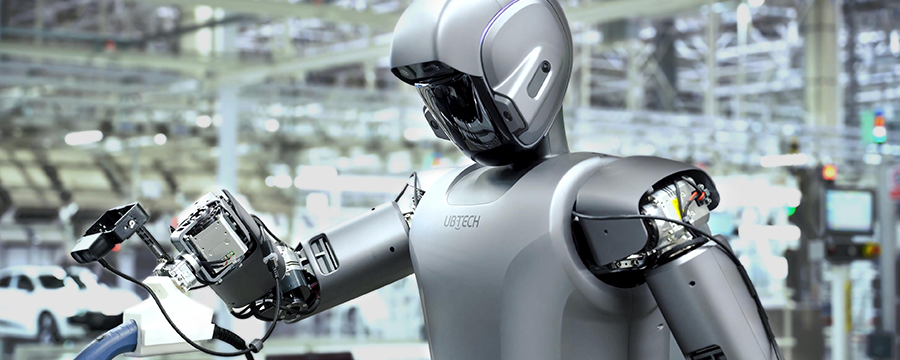 UBTECH