Ant Lingbo Technology said it has open-sourced LingBot-Touch, a tactile foundation model designed to give robot “brains” the contact sensing needed for fine manipulation, based on nearly 5,000 hours of real tactile data.
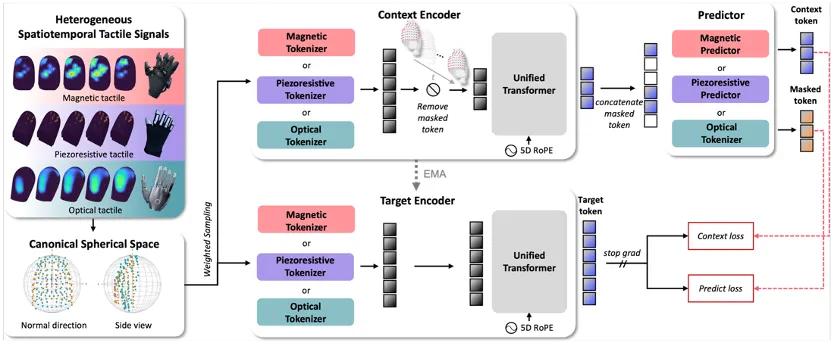
The model covers three mainstream sensing principles — magnetic, vision-based and piezoresistive tactile sensing — and converts their different raw signals into a common tactile representation for use across dexterous hands and action models, the company said.
The release extends Ant Lingbo’s embodied AI stack from visual perception and task reasoning to fingertip sensing. LingBot-Touch has been integrated with LingBot-VLA, the company’s vision-language-action model, according to Ant Lingbo.
Tactile sensing is increasingly seen as a complement to vision in robotic manipulation. In tasks such as unscrewing a bottle cap, cameras can help a robot align its fingers, but contact position, force and slip are often obscured and must be inferred through touch.
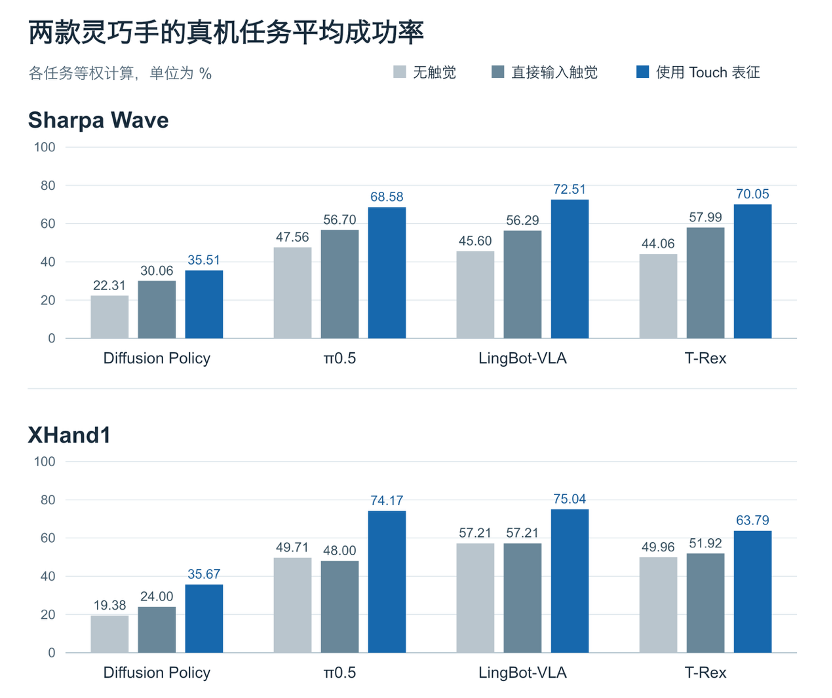
Ant Lingbo said it tested LingBot-Touch on 26 real-robot tasks using two dexterous hands, Sharpa Wave and XHand1, including page turning, bottle-cap unscrewing and mahjong tile recognition. When integrated with four action models — LingBot-VLA, π0.5, Diffusion Policy and T-Rex — average task success rates rose by about 14 to 26 percentage points compared with no tactile input.
In one example, T-Rex controlling Sharpa Wave to unscrew a bottle cap had a 56.25% success rate without tactile sensing and 62.5% with raw sensor signals. With LingBot-Touch’s tactile representation, the success rate reached 90%, the company said.
Ant Lingbo said the model is intended to reduce the fragmentation caused by different tactile sensor designs. It uses separate encoding inputs by sensing principle, maps contact points from different layouts into a unified fingertip coordinate space, and outputs unified tactile tokens. Data collected from human-worn tactile gloves and teleoperated dexterous hands can therefore be used together in training, it said.
The company also tested cross-hardware reuse on XHand1. The magnetic sensor model used by XHand1 was not included in the pretraining data, and LingBot-Touch’s parameters were kept unchanged; only the action model was trained with XHand demonstrations.
LingBot-Touch is not tied to Ant Lingbo’s own action models. The company said it provides a general perception layer between tactile sensors and action models, allowing sensor makers, robot developers and model teams to choose hardware and policies without rebuilding tactile capabilities for each combination.
Ant Lingbo offered two model sizes. All 26 real-robot tests used LingBot-Touch-Tiny, which has about 5.3 million parameters; integration with LingBot-VLA, π0.5 and T-Rex increased model parameter counts by only about 0.13% to 0.16%. The larger LingBot-Touch-Small showed further potential in perception tests, with gains from additional data as pretraining scaled to nearly 5,000 hours.
“Progress in digital-world large language models … has indeed made robots stronger in complex task reasoning and physical manipulation, and we are watching this closely and actively absorbing it,” CEO Zhu Xing said. “But frontline practice tells us that to truly close the manipulation loop, generalization in physical manipulation remains a hard nut that largely depends on breakthroughs in embodied foundation models themselves.”
Zhu said general-purpose large models and embodied foundation models have a “1+1>2” relationship, with the former improving task and environment understanding and the latter enhancing physical perception and closed-loop manipulation. “The quality of modal input largely determines the quality of action output — in other words, no good input, no good output,” he said.
Ant Lingbo said its technical report, model and code are available on Hugging Face, GitHub and ModelScope.

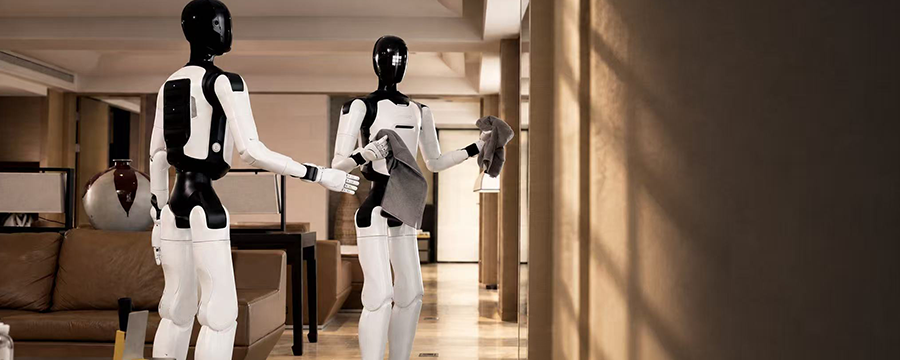 AGIBOT
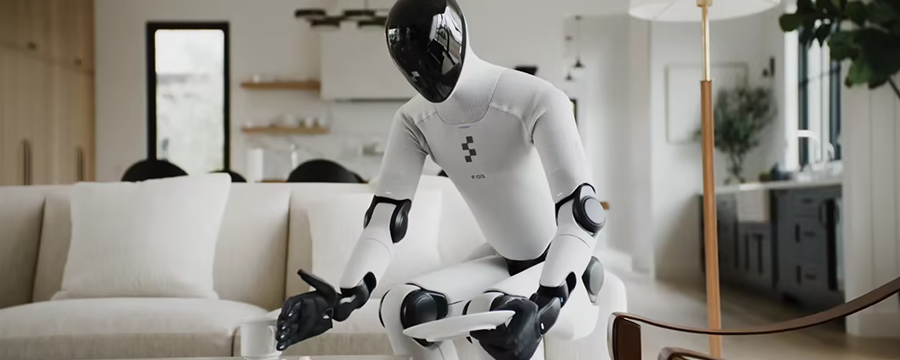 Figure AI
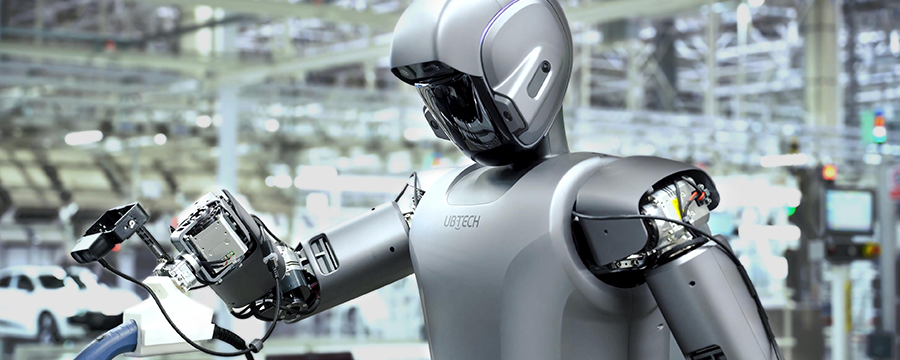 UBTECH