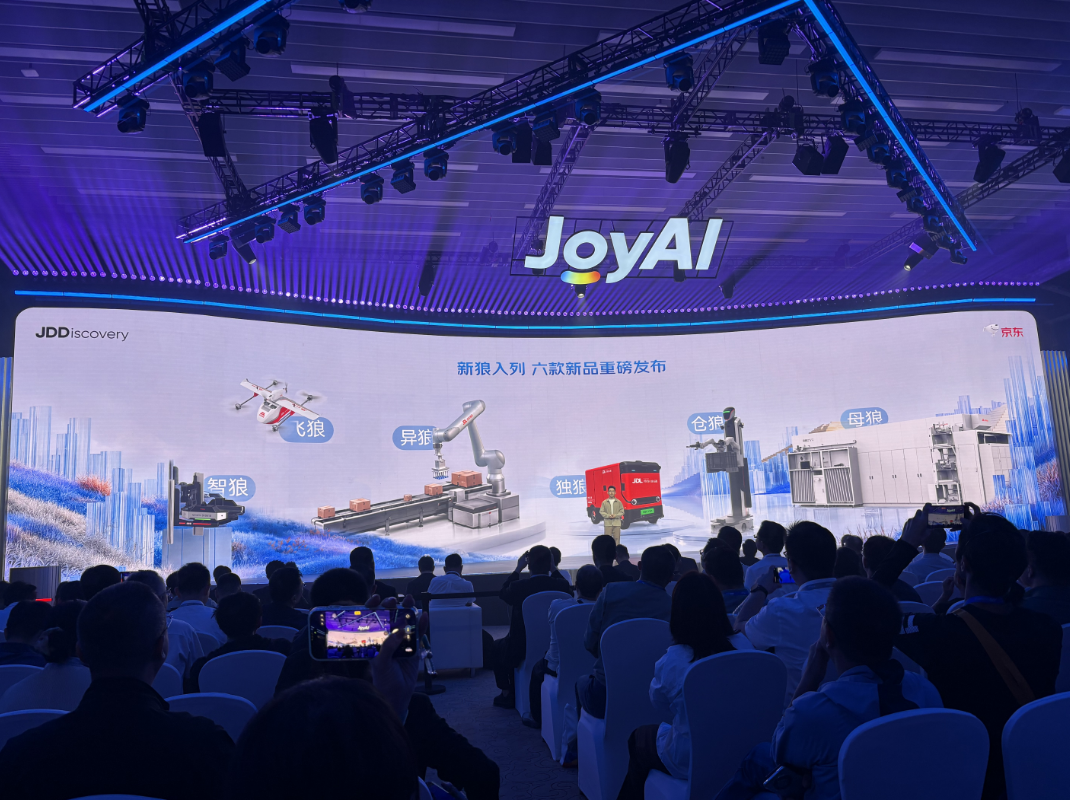
At the JDDiscovery 2026 main forum, JD.com projected its five-year procurement targets on screen: 3 million robots, 1 million autonomous vehicles and 100,000 drones. The audience included more than 100 hardware manufacturers and dozens of investment firms, many expecting humanoid robots to feature on the list. None appeared.
On exhibition zones flanking the stage, JD’s Wolf-series machines handled warehouse tasks: Dilang shuttled goods between racks, Canglang picked orders in narrow aisles, and Dulang completed campus deliveries. Not a single bipedal robot was on display.
JD unveiled six new Wolf-series robot models at the event. The omission of humanoids was no oversight. With China’s largest fulfillment network, JD’s procurement blueprint signals a clear verdict: humanoid robots are not yet commercially viable for logistics use cases.
JD’s core evaluation metric for robots processing its massive daily parcel volume is simple: can the machines move goods cheaper, faster and more reliably? Within this framework, a human-like form factor represents a cost burden, not the future.
JD’s Wolf portfolio now spans nine products across 11 variants, covering warehousing, sorting, transport and last-mile delivery. The five new models launched at the forum prioritize practical performance over human resemblance. The Canglang picking robot can be deployed in two weeks, compared with six months of downtime for conventional warehouse automation upgrades. It delivers 99.9% picking accuracy, covers over 85% of warehouse zones and handles 80 items per hour. A low-temperature variant, Zhilang, operates in -20°C cold storage with doubled storage capacity, 200% higher operational efficiency and a 10% reduction in per-unit costs.
These figures underscore JD’s stance: it does not need versatile walking humanoids, but specialized tools that outperform human workers at fixed tasks. A warehouse picker earns a modest monthly salary, while humanoid robots carry price tags ranging from hundreds of thousands to millions of yuan. Even matching human throughput would result in an untenably long payback period. Bipedal units would also face extra costs navigating narrow aisles, adapting to rack heights, maintaining stable grasping, managing battery life and ensuring safety.
As robots move from laboratories into fulfillment centers, hardware design is dictated by per-hour handling costs rather than technological idealism. JD’s order book has cast its vote: humanoids are not the solution for logistics, China’s largest robotics application scenario.